

 English




























































































































































































































































Forty Years of EFL Play-Offs Defined by One Brutal Truth

The English Football League marks forty years of the play-offs in May 2026, a knockout format that has featured 105 different teams and produced 1,468 goals before this season’s instalment. BBC Sport launched a public poll inviting fans to choose their three favourite moments from a shortlist of 15 defining memories. Voting remains open until 12:00 BST on Monday 18 May. But forty years of EFL play-offs expose one brutal truth no highlight reel captures. The format does not reward the best team across a 46-game season. It rewards whoever holds their nerve when an entire campaign collapses into a single penalty kick, a goalkeeper’s guess, or a 20-second swing from one penalty area to the other.
The Moment That Explains the Format
The ball left Anthony Knockaert’s foot at Vicarage Road on 12 May 2013 and the world split in two.
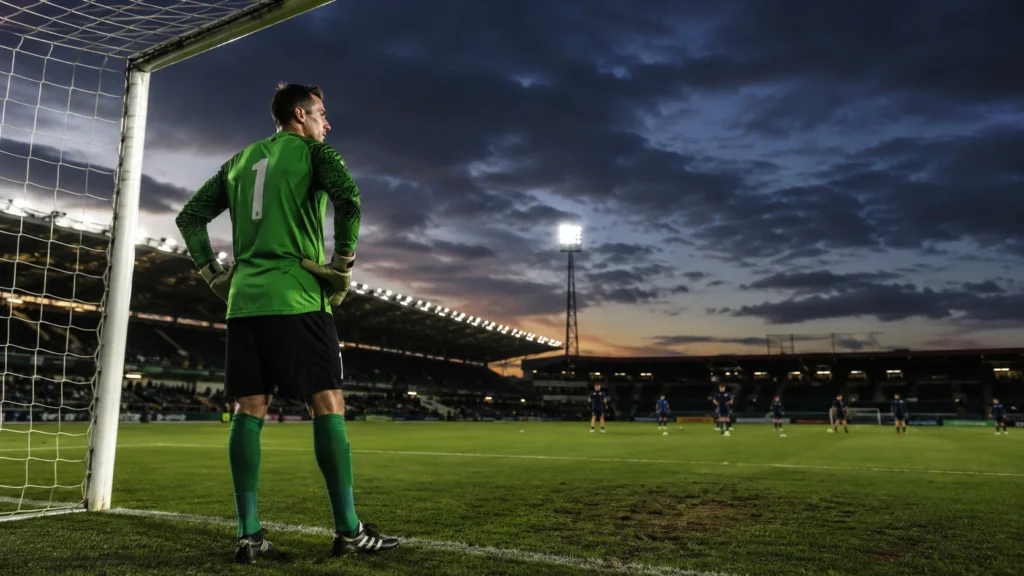
One version had Leicester City at Wembley, the penalty converted, the celebrations beginning. The other version existed only in Manuel Almunia’s reflexes. The Watford goalkeeper blocked the spot-kick. He blocked the follow-up. Then Watford counter-attacked the length of the pitch while Knockaert was still on the ground.
Troy Deeney struck the winner 20 seconds after Almunia’s save. Twenty seconds. The pendulum did not swing. It snapped.
Leicester won the Championship at a canter the following season. Watford lost the final to Crystal Palace. Neither outcome diminishes the moment itself, which now exists as permanent evidence of what the play-off format uniquely produces. No league match can replicate the psychological compression of a semi-final penalty in stoppage time with the aggregate score level.
According to EFL official play-off records and statistics, the format has delivered 1,468 goals across four decades. The goals are the surface. The structure that creates them is what matters.
Why the Format Works Against the Best Teams
The play-offs take a 46-game body of work and render it functionally irrelevant. The third-place team, which outperformed fourth, fifth, and sixth over nine months, enters the semi-final with no meaningful advantage beyond a home second leg. The format does not reward consistency. It rewards composure under a specific kind of duress no league match can replicate.
Charlton Athletic learned this in 1987. The first ever play-offs pitted fourth-bottom of Division One against fourth in Division Two. Leeds and Charlton required 300 minutes of football across three matches. Jim Melrose gave the Addicks a 1-0 lead at Selhurst Park. Brendon Ormsby levelled the tie at Elland Road. The replay at Birmingham’s St Andrew’s went to extra time.
John Sheridan put Leeds ahead. Peter Shirtliff scored in the 113th minute. Then again in the 117th.
Homeless Charlton, ground-sharing at Crystal Palace, stayed in the top flight by outlasting a team that could not finish them. The physical toll revealed the psychological truth. Charlton survived because they absorbed more pressure for longer without disintegrating.
Sheffield Wednesday staged the competition’s greatest recovery in 2023. Peterborough led 4-0 after the first leg of their League One semi-final. The tie was functionally over. Wednesday scored three times in the second leg. Liam Palmer equalised on aggregate in the 90th minute. Peterborough scored in extra time. Callum Paterson equalised again. The Owls won on penalties after Dan Butler struck the crossbar.
A four-goal lead, a 90th-minute aggregate equaliser, an extra-time advantage, and still Peterborough lost. The format catalogued every way a team can collapse and forced them to experience all of them.
The Redemption the Format Offers
Swindon Town lived both sides of the play-off equation in three years.
In 1990, Alan McLoughlin scored the winner against Sunderland at Wembley. Promotion to the top flight for the first time in the club’s history. Ten days later, the Football League found Swindon guilty of 35 counts of illegal payments, according to Football League disciplinary records 1990. Relegation replaced celebration. Two divisions down, reduced to one on appeal. Sunderland went up instead. The pitch outcome was irrelevant. The institutional ruling was everything.
In 1993, Swindon returned. Glenn Hoddle’s side led Leicester 3-0 and nearly collapsed. Three goals in 12 minutes from the Foxes levelled the tie. Paul Bodin stepped up for a penalty six minutes from time and scored. Redemption took three years and one swing of his left foot.
Dean Windass delivered the same emotional mathematics for Hull City in 2008. Discarded by his hometown club as a youth player. Returned from non-league North Ferriby. Third spell at the Tigers. Aged 39. Fraizer Campbell lifted the ball to the edge of the area. Windass volleyed it home. Hull City, the largest English city never to host top-flight football, finally had a different answer to the quiz question. The man who scored the goal was someone the club once deemed not good enough.
FAQ: Forty Years of the EFL Play-Offs
When did the EFL play-offs start?
The Football League introduced the play-offs in 1987. The first edition featured Charlton Athletic against Leeds United in a tie that required 300 minutes of football across three matches before Charlton prevailed at Birmingham’s St Andrew’s.
How many teams have competed in the play-offs?
One hundred and five different teams have competed in the EFL play-offs over four decades. Before the current season’s instalment, the format had produced 1,468 goals across all three divisions.
Which club has the worst play-off record?
Sheffield United have failed in 10 play-off campaigns, the worst record in Football League history. Leeds United, Leicester City, and Nottingham Forest have all experienced memorable collapses during the format’s history.
Why are the play-offs considered unfair?
The format takes the third-place team, which outperformed fourth, fifth, and sixth across a 46-game season, and offers no meaningful advantage beyond a home second leg. The structure rewards composure under pressure rather than long-term consistency. That is not a design flaw. It is the design.
Who scored the fastest famous play-off goal?
Troy Deeney’s winner for Watford against Leicester in 2013 arrived 20 seconds after Manuel Almunia saved Anthony Knockaert’s penalty at the other end. The goal is the most famous momentum swing in play-off history and defined the format’s capacity to reverse an entire season in under half a minute.
The Legacy That Outlasts the Money
The play-off final at Wembley is marketed as the richest game in football. The Premier League broadcast revenues await the winner. The financial stakes grow larger every season. But Tom Watson’s winner for Sunderland against Sheffield United in the 2025 final explains why the money is secondary.
Watson had already agreed to join Brighton for £10 million. Sections of the Sunderland support booed him weeks earlier after the transfer announcement. In the 95th minute, with the final poised at 1-1, Kieffer Moore misplaced a pass and Watson buried a low shot from outside the area. He ripped off his shirt. He slid on his knees.
The fans who booed him celebrated with him. The transfer proceeded. The goal did not change his future. It changed how Wearside remembers him. That matters more than any broadcast contract.
Michael Gray took Sunderland’s seventh penalty in the 1998 shootout against Charlton. Sasa Ilic saved it. Sunderland won 105 points the following season and went up automatically. Gray’s penalty still gets mentioned first whenever that era is discussed.
Forty years. One thousand four hundred and sixty-eight goals. One hundred and five teams. The format survives because the league table cannot manufacture what a penalty shootout at Wembley does to a career. The format does not create drama. It reveals who can survive it. The BBC Sport poll remains open until 12:00 BST on Monday 18 May.
Written by Senior Football Correspondent, who has covered the English Football League, the play-offs, and the intersection of sport and psychology for over a decade, including every Championship, League One, and League Two play-off campaign since 2015.