

 English




















































Hockney Painted the Splash. The Swimmer Was Already Gone.
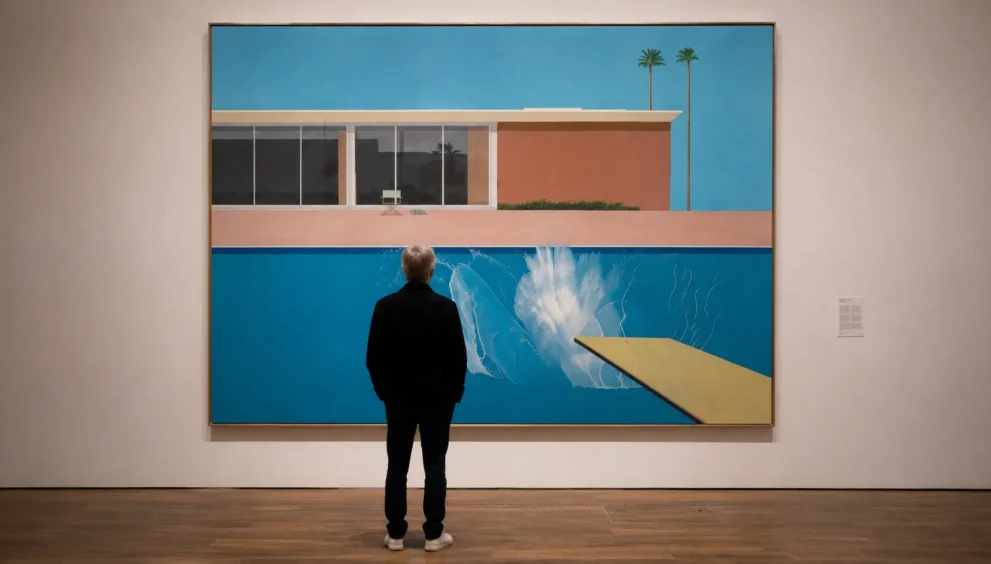
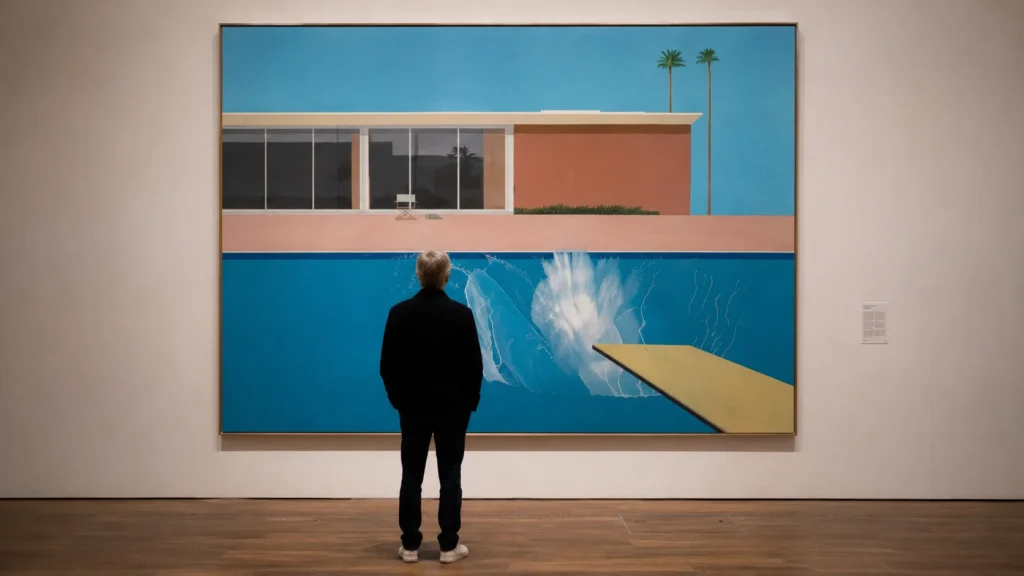
The splash is white. The water is turquoise. The diving board is empty. The swimmer has vanished. David Hockney’s A Bigger Splash, completed in 1967, three years after he moved from London to Los Angeles, is a painting about presence and absence. The presence is the explosion of pool water, suspended mid-air with a precision that took the artist weeks to achieve. The absence is the body that produced it. The diver is not visible. The diver is not coming back. The splash is the only evidence that anyone was ever there.
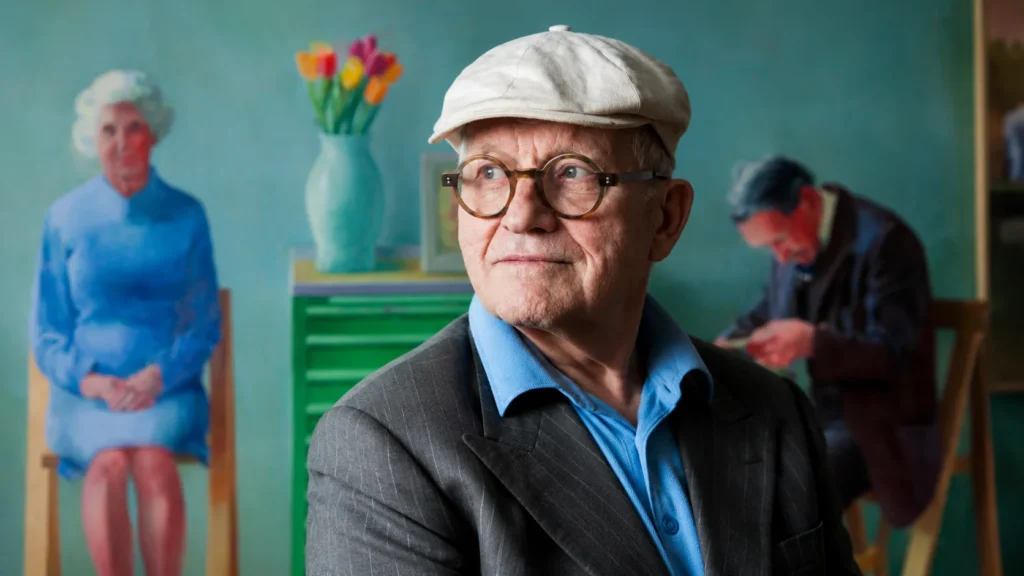
Hockney died on Thursday, aged 88. The painting remains at the Tate. The relationship between them has shifted. A work that was always about the fleetingness of being—about the moment when the evidence of a life is still visible but the life itself has departed—now reads as a premonition. The artist who spent his career teaching us how to look at light, water, colour, and the California sun has become the absent swimmer. The splash is his body of work. The splash is still there.
The canvas was constructed from fragments. Hockney did not witness the splash and paint it from observation. He found a photograph in a technical manual about swimming pool construction, published by Sunset Books in 1959. The photograph showed a splash made by an unseen diver. Hockney removed a pair of poolside onlookers, fused the image with a stylised version of a building he had been sketching, and set to work. The painting took weeks. The splash, which appears instantaneous, was built slowly, layer by layer, from borrowed sources and patient labour. Spontaneity is an illusion. The illusion is the point.
This is not an isolated event. This is a structural shift in how an artist’s death recalibrates the meaning of his most famous image. A Bigger Splash was always about the relationship between what remains and what has gone. Hockney’s death does not change the painting. It changes what we bring to it. The empty diving board now has a name.
The Sources Beneath the Surface
Hockney arrived in California with a visual vocabulary that had been accumulating for years. The year before he left London, he visited Egypt. He left his camera behind. He spent his time studying and drawing tomb art he had first encountered at the British Museum as a student—the flatness of ancient frescoes, the stylised statuesque figures, the calm, cool colours. Those colours rhymed in his mind with the early Renaissance frescoes and tempera panels of Masaccio, Fra Angelico, and Piero della Francesca, artists he had admired since his student years.
The chaotic and cluttered compositions he had been pursuing before Egypt suddenly made no sense. The crispness of Egyptian reliefs and the tranquillity of 15th-century Italian painting offered a different path. When he arrived in Los Angeles, those influences merged with the bold language of American Pop Art—Andy Warhol’s soup cans, Roy Lichtenstein’s comic book explosions. The question became: what happens when you combine the commercial punch of Pop with the stillness of ancient frescoes?
A Bigger Splash was the answer. The painting’s flat, abstracted shapes echo the palette and contours of contemporary abstract artists such as Richard Diebenkorn. But the stillness beneath the splash, the sense of frozen time, belongs to a much older tradition. The work is a fusion of photography and drawing, ancient frescoes and cutting-edge aesthetics, Egyptian tomb art and Sunset Books technical manuals. The millennia are compressed into a single frame. The compression is invisible unless you know where to look.
The Technology of Looking
Hockney never stopped experimenting with the relationship between technology and image-making. The photocollages of the 1980s used multiple photographs to create composite images that mimicked the way the eye actually moves across a scene. The iPad drawings of his later years—landscapes of the Normandy countryside, produced during the Covid-19 pandemic—were a continuation of the same investigation by other means. The tool changed. The question remained the same: how do you capture the act of looking?
A Bigger Splash used a photograph as its invisible scaffold. Hockney did not hide this. He understood that photography could freeze a moment, but could not interpret it. Interpretation required paint. The splash in the painting is not a photograph of a splash. It is a painting of a photograph of a splash, reconstructed over weeks to look more real than the original. The paradox is deliberate. The photograph captured the instant. The painting recreated the instant. The recreation took longer. The recreation lasts longer.
The painting is an argument about the primacy of paint and the imagination of the painter. The camera can record what the eye sees. The painter can orchestrate what the viewer feels. The distinction matters. Hockney spent his career defending it. The market that turned his pools into nine-figure auction records has sometimes obscured it. The painting itself does not.
The Empty Diving Board
The swimmer in A Bigger Splash is not coming back. The painting has always been about this. The splash is the vibrant proof of a presence that has slipped away. The proof is luminous. The proof is fragile. The proof depends on the viewer’s understanding that what produced it is gone.
Hockney’s death does not change the painting’s meaning. It completes it. The artist who painted the splash has now joined the diver beneath the water. The splash remains. The body of work remains. The Tate still holds the canvas. The public still stands before it, looking at the white explosion of water, the turquoise stillness of the pool, the empty diving board, the California light. The painting taught us how to look at absence when the absence was theoretical. Now the absence is real.
The foundation Hockney established to manage his work will now manage his legacy. The market will price the remaining works. The retrospectives will be organised. The iPad drawings will be exhibited alongside the pools. The photocollages will be studied alongside the stage designs. The canon will absorb him. The canon will simplify him. The splash will become the signature image. The signature image will mean more now than it did when he was alive. That is how death works in the cultural economy. The artist departs. The work accrues meaning. The meaning is not always what the artist intended.
Hockney understood this. He painted the splash. He left the diver out. He knew the viewer would supply the rest.