

 English









































































































































































































He Sang “Wild Thing.” His Memorial Is a UFO on a Pub Wall.
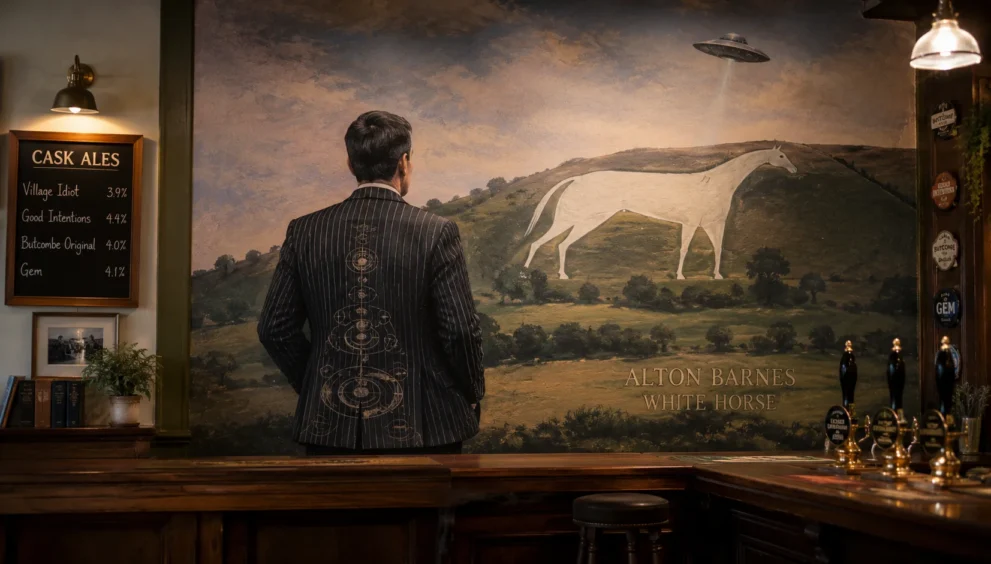
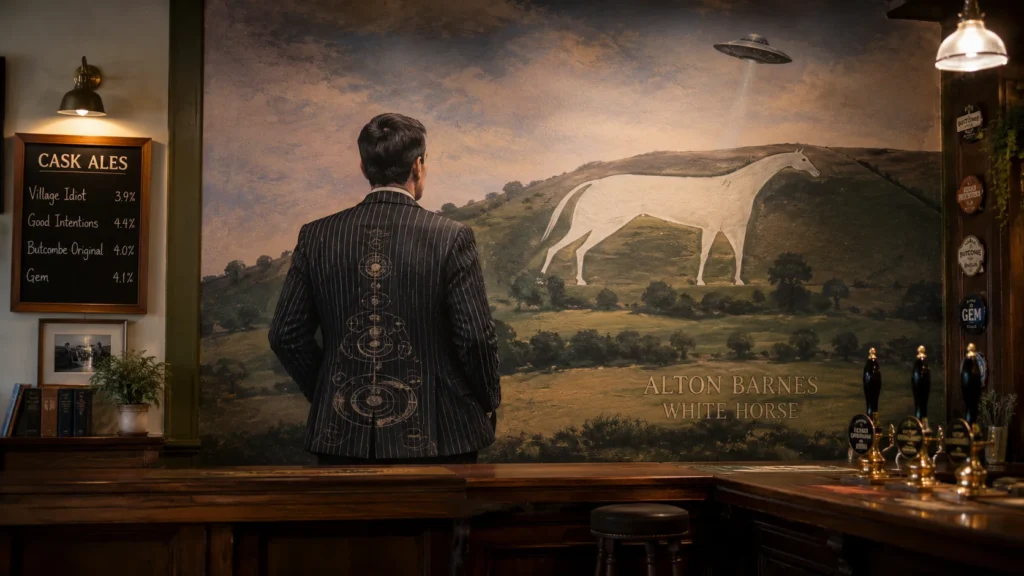
The mural sits inside The Barge Inn near Pewsey in Wiltshire, a pub that served for years as an unofficial headquarters for crop circle researchers and UFO enthusiasts. On the wall, Reg Presley—frontman of The Troggs, voice of “Wild Thing” and “Love Is All Around”—stands against the North Wiltshire Downs. The Alton Barnes White Horse is carved into the hill behind him. A UFO hangs in the sky, small and deliberate, the kind of detail that only matters if you know why it is there.
Presley died in 2013 of lung cancer. He was a regular at this pub during the 1990s, not for the beer but for the company. The crop circles drew him. The paranormal drew him. The royalties from “Love Is All Around”—a song that sat at number one for 15 weeks in 1967, then returned to the charts decades later via a Wet Wet Wet cover—funded his research. He published a book in 2002 called Wild Things They Don’t Tell Us. The title did what his life did: it took the thing he was famous for and pointed it toward the thing he actually cared about.
The artist Paul Boswell painted the mural. He had already done a 20-metre piece commemorating the Warminster Thing—a string of UFO sightings in Wiltshire in the 1960s. He took Presley’s iconic pinstriped suit, the one the band wore in their press photos, and turned the stripes into crop circles. The conceit is quiet. It does not announce itself. It sits on the wall of a pub where Presley once talked to strangers about things he could not explain.
So what is actually happening here? A musician who wrote one of the most commercially successful songs of the 20th century has been commemorated not for the song but for what the song enabled. The mural honours the part of his life that had nothing to do with music and everything to do with who he actually was. The commemoration is local. The medium is paint on a pub wall. The subject is not fame. The subject is curiosity.
The Royalties and the Research
“Love Is All Around” is the kind of song that outlasts its context. The Troggs released it in 1967. Wet Wet Wet covered it in 1994 for the Four Weddings and a Funeral soundtrack. It stayed at number one for 15 weeks. The royalties from both versions gave Presley something most musicians do not get: the freedom to pursue an obsession that had nothing to do with the industry that made him famous.
In 1990, he visited a large crop circle in Alton Barnes. The visit reorganised his attention. He began spending time in Wiltshire, at The Barge Inn, talking to researchers and enthusiasts who treated the unexplained not as a punchline but as a field of inquiry. He published his book in 2002. The title, Wild Things They Don’t Tell Us, was a joke at his own expense and a serious statement of intent. The things they don’t tell us interested him more than the things they did.
His wife, Brenda Ball, described him as “the most unfamous famous person we knew.” The phrase captures something specific. Presley did not hide from his fame. He just did not organise his life around it. The pub regulars who knew him as the crop circle researcher, not the rock star, were not being deceived. They were being offered a different version of the man, one he preferred.
The Mural as Local Memory
Boswell’s mural does not belong to the tradition of rock star iconography. There is no stadium. There is no microphone. There is no lyric quoted in dramatic lettering. There is a man in a pinstriped suit, a chalk horse carved into a hillside, and a UFO. The elements are specific to a place and a person. They would not work anywhere else.
The pub’s owner, Alistair Sinclair, said the mural “gladdened” his heart. The word is careful. It suggests a quiet pleasure rather than a public spectacle. Presley’s family attended the unveiling alongside fans who had crowdfunded the piece. Boswell called it a “touching evening.” Ball called the mural “absolutely lovely” and said it “came as a complete surprise.”
The surprise matters. Memorials are often negotiated in advance—committees, approvals, the slow machinery of public commemoration. This mural was not. An artist decided Presley deserved one. A pub agreed. Fans paid for it. The family saw it when it was done. The process inverted the usual order. The result is a memorial that feels personal rather than official, local rather than institutional.
What Gets Commemorated
The tension here is Commercial Value vs Artistic Integrity, but not in the usual sense. Presley’s commercial success was enormous. “Wild Thing” and “Love Is All Around” are part of the permanent architecture of pop music. A conventional memorial would have centred them—a statue in a hometown square, a plaque on a recording studio, a museum exhibit with gold records and vintage photographs.
The mural at The Barge Inn centres on something else. It centres the part of Presley’s life that the commercial success made possible but did not define. The crop circles. The UFO research. The conversations in a Wiltshire pub with people who shared his fascination with the unexplained. The pinstripes turned into crop circles. The white horse on the hill. The cheeky little UFO in the sky.
This is a different kind of commemoration. It does not celebrate the product. It celebrates curiosity. The distinction matters because it raises a question about what we choose to remember. Presley wrote songs that millions of people loved. The mural remembers the part of him that those songs funded. It remembers the man who, after the hits stopped and the royalties accumulated, drove to Wiltshire to look at strange patterns in the fields and talk to strangers about what they might mean.
What Comes Next
The mural will stay on the wall of The Barge Inn. People who know The Troggs will find it and learn about the crop circles. People who know the crop circles will find it and learn about The Troggs. The two audiences will continue to overlap in ways Presley himself embodied. The mural does not explain the connection. It simply presents it.
Boswell’s work joins a tradition of local memorials that bypass institutional gatekeeping. Crowdfunded, artist-initiated, and sited in a specific place for a specific community, the mural does not need permission from the music industry or the art world. It exists because people who remembered Presley wanted it to exist. The process is as significant as the product. The commemoration is the act of people who knew him—not as a star, but as a regular—deciding that his presence should remain visible in the place where he chose to spend his time.