

 English






















































































































































































































































































































































Christie’s Sold $1.1B in Art. The Artists Were All Dead.
The gavel fell on Lot 1 at just past seven. Forty minutes later, $630 million had changed hands. Jackson Pollock’s *Number 7A, 1948*—a drip painting of a scale few private hands still hold—climbed past $100 million, then $150 million, then landed at $181.2 million with fees. Applause. The previous Pollock record, set in 2021, was $61.2 million. It did not survive the evening.
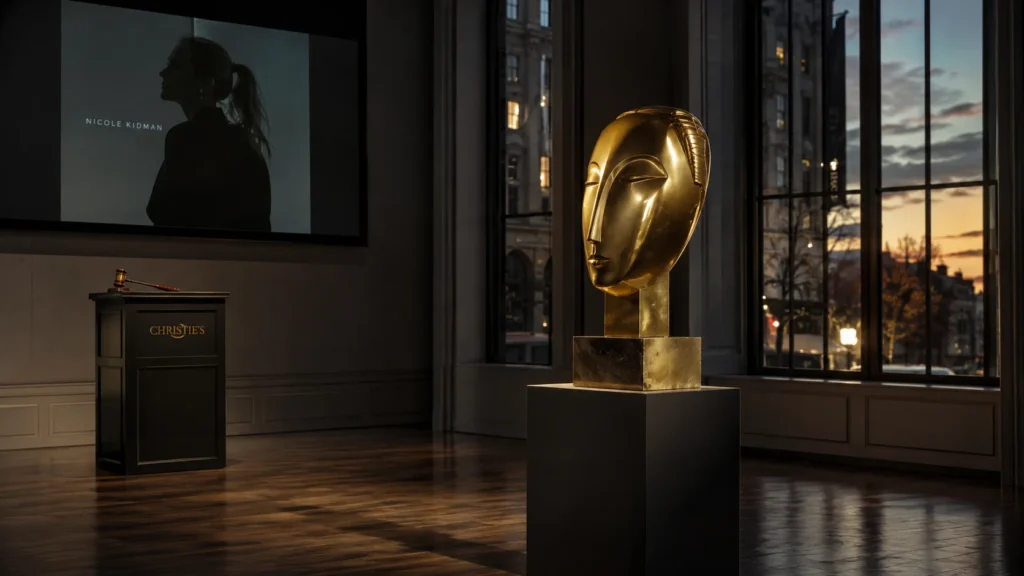
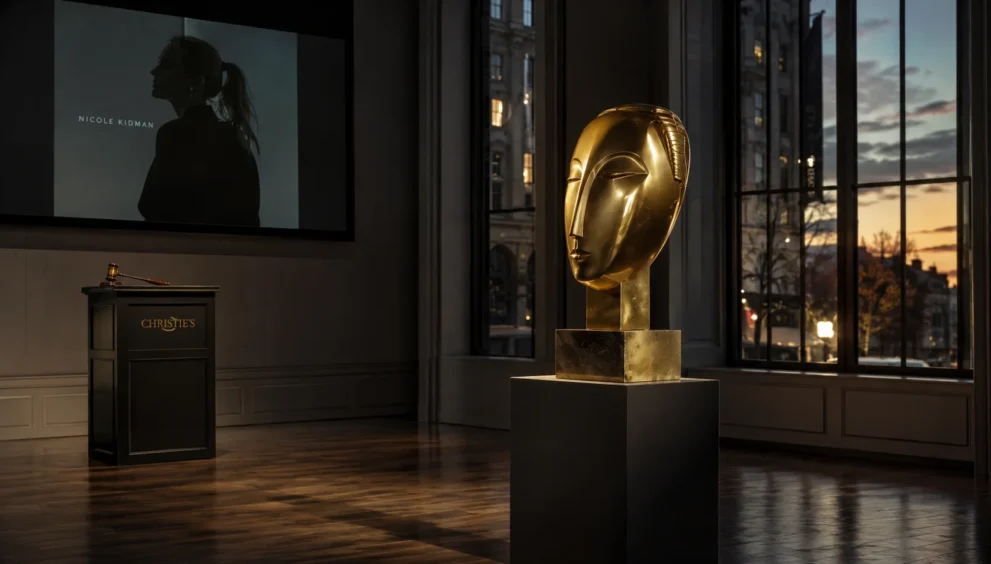
Constantin Brancusi’s Danaïde, a golden bust of a Greek myth rendered in modernist reduction, took $107.6 million. The previous Brancusi record was $71.2 million. That did not survive either.
Later in the night, Mark Rothko’s No. 15 (Two Greens and Red Stripe) fetched $98.4 million from the collection of former Museum of Modern Art president Agnes Gund. Another record. The evening’s total reached $1.1 billion. The room was full. The bidding was brisk. The auctions were not about art. They were about supply.
Nicole Kidman appeared in a promotional video for Christie’s, encountering the Brancusi bust in a free-flowing black-and-white homage to Man Ray’s 1930s film of Lee Miller. She did not break the internet the way her AMC ad did. She did not need to. Twenty thousand visitors came to see the works before they disappeared back into private hands. The campaign was one of many approaches, Christie’s post-war and contemporary art chair Sara Friedlander explained. Brancusi was “such a modern innovator,” she said, “and so I think for us to do things that are innovative around extraordinary objects is something we, too, are experimenting with.”
The experiment worked. The auction house sold the works. The records fell.
So what is actually happening here? The art market just staged a $1.1-billion evening that had almost nothing to do with artistic innovation and almost everything to do with the mechanics of scarcity. The records did not reflect a surge in creative genius. They reflected widows downsizing, estates liquidating, and a handful of billionaires competing for objects that will not reappear on the market for a generation—if ever.
The Supply-Side Auction
The numbers are staggering. The numbers are also misleading. Christie’s did not sell $1.1 billion in art because the art world is thriving. It sold $1.1 billion in art because a specific set of conditions aligned.
S.I. Newhouse’s collection anchored the evening. Newhouse owned Condé Nast and a large slice of America’s local newspapers and broadcast stations. He died in 2017. His collection has come to market in tranches—including the 2019 sale of Jeff Koons’s Rabbit for $91 million, which made Koons the most expensive living artist by public auction record. This fourth tranche was motivated, in part, by apartment space. Victoria Newhouse, his widow, told The New York Times she was scaling down. “I’m not getting any younger,” she said. “It’s an effort to simplify my life.”
Agnes Gund’s three works added another layer. The former MoMA president sold a Rothko that set a record. The sale was not random. It was the latest in a series of high-profile single-owner dispersals—Paul G. Allen’s $1.5-billion night in 2022, Leonard A. Lauder’s collection, Pauline Karpidas’s estate. The auction houses have courted these collections aggressively because they solve a structural problem. The top end of the market depends on masterworks by 20th-century artists. Those works are in private hands. The hands are aging. The estates are liquidating. The supply is finite.
The demand side is finite, too. Artnet counts no more than 30 “whales”—the market’s biggest spenders—with the power to make or break a major auction. A single decisive lot can buoy an entire evening. The Klimt that sold for $236.4 million last fall did exactly that. The Pollock did it on Monday. The records cluster around the outliers. The outliers mask the uncertainty beneath.
The Kidman Question
Christie’s did not need Nicole Kidman to sell the Brancusi. The Brancusi would have sold anyway. The golden bust of Danaïde—a daughter of Danaus condemned to carry water in a sieve for eternity, rendered by Brancusi as a streamlined oval head—was going to break a record regardless of who posed with it in a promotional video.
The video mattered for a different reason. It signaled that the auction houses understand something about the contemporary attention economy: even the ultra-wealthy scroll Instagram. Even billionaires respond to cultural saturation. The campaign was not about convincing anyone to buy the Brancusi. It was about making the Brancusi feel like a cultural event rather than a financial transaction. The distinction is important. Auctions are transactions. The marketing transforms them into something that feels closer to entertainment.
The Kidman video did not go viral the way her AMC ad did. It was not designed to. It was designed to circulate in the specific ecosystem of people who might plausibly bid on a $100-million sculpture or influence someone who would. The 20,000 visitors who came to Christie’s before the sale were not all whales. They were the audience. The whales were the buyers. The Kidman video connected the two.
The Artists Who Were Not in the Room
Pollock died in 1956. Brancusi died in 1957. Rothko died in 1970. None of them saw their records fall. None of them benefited from the $1.1-billion evening. The auction market is a secondary market. The artists are not paid. The estates are not always paid—Newhouse’s collection benefits his heirs, not the painters and sculptors whose work appreciated over decades while they were dead.
The tension here is Commercial Value vs Artistic Integrity. The market assigns prices to objects. The prices reflect scarcity, provenance, and the competitive dynamics of a specific room on a specific night. They do not reflect artistic quality in any stable or meaningful sense. Pollock’s Number 7A, 1948, is not inherently worth three times his previous record. The market conditions changed. The supply of comparable works shrank. The room was ready. The price followed.
None of this diminishes the art. The Pollock is still a masterpiece. The Brancusi is still a modernist landmark. The Rothko still glows with the particular luminosity that makes Rothko rooms feel like secular chapels. But the prices are not about the art. They are about the art’s availability. The distinction matters because the market conflates them constantly. A record-breaking sale is reported as a triumph for the artist. The artist is dead. It is a triumph for the seller.
What the Market Is Actually Saying
The $1.1-billion evening is a signal of strength at the very top of the market. It is not a signal of health across the market. The whales are still spending. The masterworks are still commanding premiums. But the number of works capable of generating these sums is vanishingly small, and the number of buyers capable of paying them is smaller still.
The auction houses know this. They are competing for single-owner collections because single-owner collections concentrate the supply. They are experimenting with celebrity promotional videos because the spectacle of the auction now competes with every other form of luxury entertainment. They are breaking records because records generate headlines, and headlines generate interest, and interest eventually generates consignments.
The cycle works until it doesn’t. The Klimt record last fall papered over uncertainties. The Pollock record this spring will do the same. The uncertainties remain: concentration of buyers, dependence on estate liquidations, and the absence of a deep bench of emerging artists capable of commanding these prices. The market is top-heavy. The top is doing fine. The rest is not the story.
What Comes Next
More single-owner collections will come to market. More records will fall. More widows will downsize. More promotional videos will feature actors encountering sculptures in black and white. The auction houses will continue to compete for the finite supply of 20th-century masterworks because the 21st century has not yet produced enough artists whose work can anchor a $1.1-billion evening. When it does, those artists will be dead too. The secondary market always waits for the primary market to end.