

 English


















































































































































































































































































































































































$200M AI Chips: Cerebras Burn Millions Before Wafer Shift
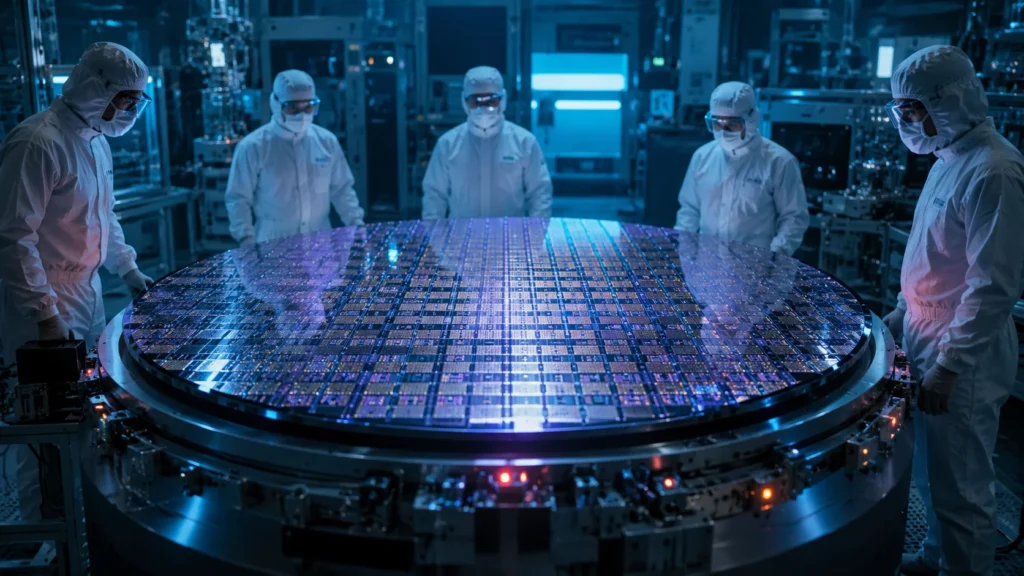
AI chips, Cerebras wafer-scale computing, reveal a deeper shift in how artificial intelligence gets built, funded, and controlled. Cerebras Systems burned nearly $200 million and operated at roughly $8 million per month in 2019 while attempting to build wafer-scale AI hardware that replaces traditional multi-chip clusters. The breakthrough didn’t just change chip design—it exposed a new dependency between AI progress and physical manufacturing limits.
THE ENGINEERING BET AGAINST PHYSICS
Inside Silicon Valley’s AI infrastructure race, Cerebras Systems made a decision most chip companies avoided. Instead of dividing computing across multiple processors, it built one massive wafer-sized chip designed to act as a single computational surface.
That decision reshaped everything.
Latency disappeared inside the chip itself. Communication delays between processors collapsed. But physical reality pushed back immediately—heat density, power delivery, and structural stress multiplied faster than expected.
As AI hardware scaling bottlenecks in semiconductor design showed, traditional chip architecture assumes modular failure tolerance. Cerebras removed that safety layer entirely.
According to TechCrunch reporting (2024 interview with Andrew Feldman, CEO), the company burned roughly $8 million per month in 2019, consuming nearly $200 million in funding before the first stable wafer system worked.
Short sentence. Pressure builds.
The system didn’t just require engineering. It required new physics-compatible manufacturing behavior.
THE INDUSTRY THAT COULDN’T FOLLOW
Most semiconductor firms scale through incremental improvements. TSMC, Intel, and AMD optimize smaller dies, not full wafer integration.
Cerebras inverted that model.
Cooling systems did not exist for wafer-scale chips. Packaging vendors refused early collaboration because there was no standard process applied. Even mechanical assembly became experimental—engineers reportedly designed custom multi-screw fastening machines just to mount wafers without cracking them.
As evolution of AI compute infrastructure and cloud hardware dependency highlighted, modern AI no longer scales through software alone. Hardware now dictates model capability ceilings.
According to TSMC manufacturing ecosystem documentation (2025), advanced packaging yields for non-standard architectures can drop into double-digit variability ranges during early production cycles, significantly raising per-unit risk compared to conventional chiplets.
TSMC official semiconductor manufacturing insights
Fragment. Nothing scaled cleanly.
THE TENSION: DEPENDENCY VS CONTROL
Here’s the shift most people miss.
AI computing no longer depends only on algorithms. It depends on physical manufacturability at an extreme scale.
Cerebras didn’t just build a chip. It built a dependency chain:
- AI models demand more compute
- Compute demand forces larger hardware surfaces.
- Larger hardware forces specialized fabrication ecosystems.
Each layer removes flexibility from software companies and hands control to semiconductor infrastructure providers.
So control moves.
From AI developers → to hardware architects
From startups → to fabrication giants
From cloud abstraction → to physical constraint systems
And that shift changes strategy across the entire industry.
So what happens next?
WHAT THIS REVEALS ABOUT THE FUTURE
Between 2024 and 2026, AI infrastructure companies increasingly prioritize hardware access over model optimization. Cerebras positions itself inside cloud ecosystems like AWS inference pipelines, where wafer-scale chips serve high-throughput workloads instead of general-purpose training.
According to Reuters semiconductor supply chain reporting (2025), AI hardware demand growth now outpaces traditional chip production expansion cycles by a widening margin, forcing cloud providers to lock in long-term compute contracts earlier than previous infrastructure generations.
Reuters semiconductor and AI infrastructure coverage
The result feels subtle. Then irreversible.
Companies stop asking “how efficient is the model?”
They start asking, “Can we get enough compute?”
Speed turns into negotiation.
Not software.
FUTURE CASCADE
Cerebras expands inference deployments across enterprise AI systems and cloud partners. Demand increases for wafer-scale throughput, especially in large model serving environments.
But dependency deepens.
Every performance improvement ties directly to manufacturing yield stability. One bottleneck in packaging slows deployment across entire cloud ecosystems.
New behavior emerges inside AI companies: hardware procurement teams gain influence equal to model research teams. Infrastructure becomes strategy.
Slowly, software loses final authority.