

 English










































































































































































































































































































































































Humanoid Robot Soldiers: Foundation Robotics’ Phantom Explained
Foundation Robotics, a two-year-old San Francisco startup, is developing humanoid robots for military applications, including frontline combat—the only US company openly doing so. The current model, Phantom MK-1, cannot operate without external power, cannot withstand dust or water, cannot get back up if it falls, and lacks functional hands capable of gripping tools or weapons. The company has $24 million in US military research contracts. Ukraine is testing two units with weaponization included. CEO Sankaet Pathak aims to produce 40,000 units annually by the end of 2027 at under $20,000 each. Eric Trump recently joined as an investor and advisor. The company positions itself as America’s answer to Chinese military robotics development. The Pentagon is interested. The engineering isn’t ready.
The Question Everyone Is Asking
Can humanoid robots actually fight on a battlefield?
Not yet. The current Phantom MK-1 cannot open a door, walk in rain, or stand up after falling. It trains its AI by playing with colored children’s blocks in a San Francisco industrial space—a process the company calls “free play,” designed to generate data about how the robot interacts with its physical environment. The second-generation MK-2, under construction, promises six-hour battery life, weatherproofing, self-recovery from falls, and hands capable of firing weapons. Whether Foundation can deliver on those promises will determine whether humanoid robot soldiers remain science fiction or become procurement reality.
Robert Griffin, who works on humanoid robots at the Florida Institute for Human and Machine Cognition, describes the core challenge: getting a robot to jump through a window of unknown height, land on uneven ground, and immediately navigate an unfamiliar interior. “These autonomous systems don’t know how to handle open-ended uncertainty yet,” he says. Human soldiers have foiled AI by doing what is “out of the ordinary”—somersaulting, putting cardboard boxes over their heads. Dean Fankhauser at Robozaps, a humanoid robotics advisory firm, notes today’s commercial humanoids “can barely handle warehouse packing, let alone open a door.” He describes the idea of China militarizing humanoids effectively in a near-term conflict as “fanciful.”
What Foundation Robotics Is Building
Foundation Robotics was founded by Sankaet Pathak, who previously co-founded Synapse, a financial services firm that filed for bankruptcy in 2024. The company’s Phantom robot uses an AI system called Cortex that combines two types of models: a “reasoning model” trained on task-specific examples, and a broader “world model” trained on internet videos and physical interaction data—including the block-playing sessions.
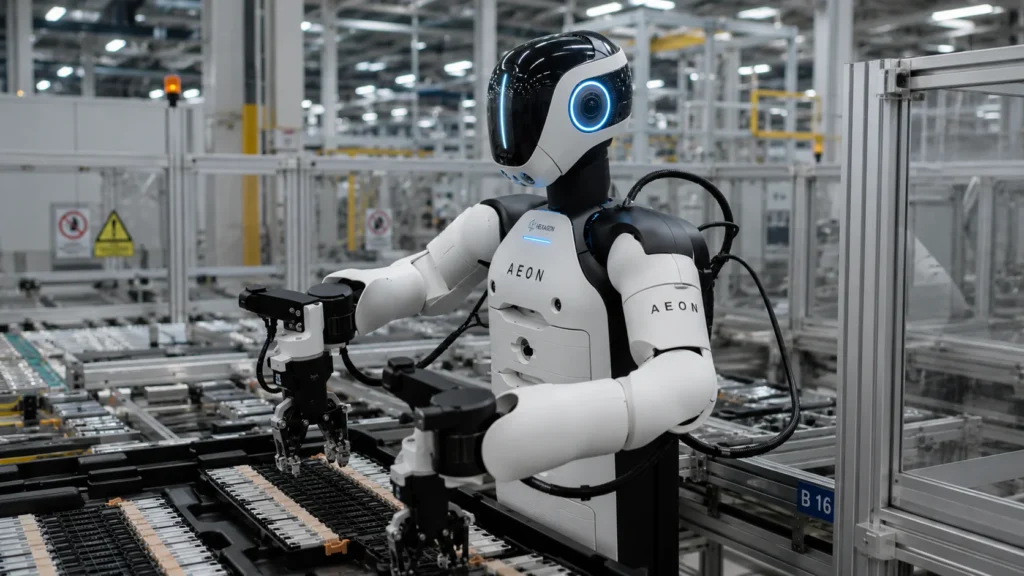
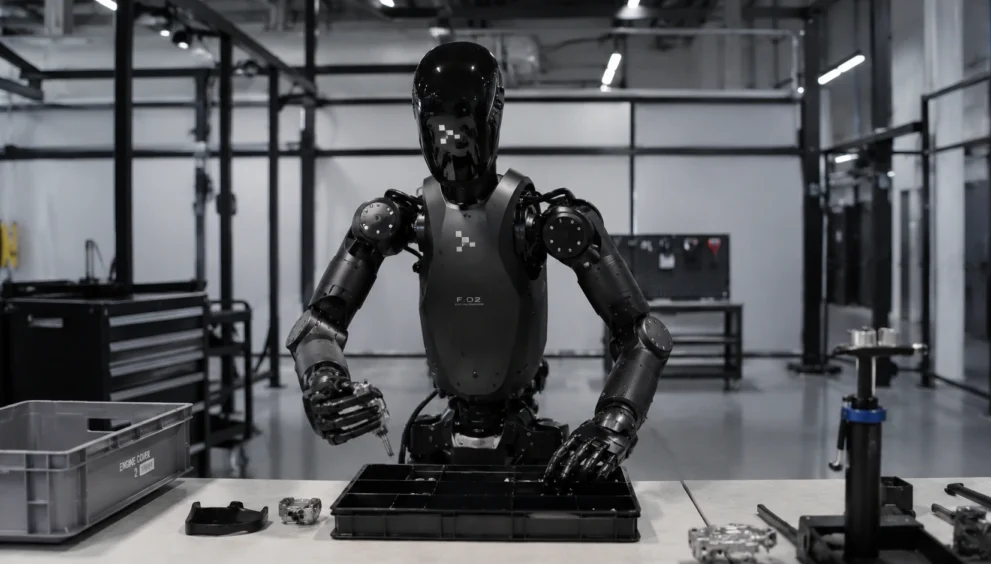
The MK-1 weighs 80 kilograms, has a black faceless head with 360-degree cameras, and remains a development prototype. The MK-2 will add a large battery targeting six hours of runtime, weatherproofing, fall recovery, and improved hands with wrists designed for weapon recoil. The Foundation Robotics official company announcements and technology specifications detail the development roadmap.
The US military pilot program limits the robot to handling rather than firing weapons. Ukraine’s testing includes weaponization. The distinction means the first real combat data on humanoid performance will emerge from an active war zone rather than controlled testing environments.
Pathak argues that humanoid form factors make sense because the world is built for humans—from screwdrivers to weapons, there is no need to reinvent existing tools. The argument is elegant. The engineering isn’t there yet.
The Ethics: Human-in-the-Loop and Its Exceptions
Foundation positions itself as committed to keeping humans “in the loop” for lethal decisions, requiring approval before the system uses force. Pathak then adds exceptions: scenarios where autonomous firing might be necessary to avoid catastrophic outcomes, where human authorization is “less critical.”
The exceptions are the future. Autonomous systems that require human approval represent a phase. Autonomous systems that operate beyond human reaction time represent the endpoint. The military logic pushes inexorably toward speed. A robot that waits for permission is slower than one that doesn’t. In combat, slower loses.
Nicole van Rooijen, executive director of the Stop Killer Robots coalition, finds the humanoid form “extra worrying.” She argues human-like machines may appear familiar and trustworthy as civilian use grows, lowering barriers to accepting military deployment. The same robot that stacks boxes in a warehouse could, with different software and better hands, clear a building. The dual-use problem is built into the form factor.
Other legged-robot companies have drawn a line against weaponization. Foundation is the only US firm that has crossed it openly. Pathak argues it is dangerous that more companies aren’t following his lead. The Stop Killer Robots coalition position papers on autonomous weapons systems and humanoid platforms provide the counter-framework.
As our analysis of autonomous weapons development and the erosion of human control in military AI systems documented, the ethical guardrails shift with each technological advance. The debate over humanoid weaponization is occurring before the machines can do what either side fears or desires.
FAQ
Can Foundation Robotics’ humanoid robot actually fight?
Not yet. The current Phantom MK-1 cannot operate independently without external power, cannot function in dust or water, cannot stand up after falling, and lacks functional hands. The MK-2 promises to address these limitations but remains under construction. The company trains its AI using children’s blocks because the robot needs basic interaction data before attempting complex tasks.
How much has the US military invested in Foundation Robotics?
The company holds $24 million in research contracts to pilot its technology with the US military. The Pentagon’s program limits testing to handling rather than firing weapons. A separate US Army contest seeks humanoids that could support soldiers across a wide range of tasks. The military interest is genuine. The capability isn’t there yet.
Why is Ukraine testing Foundation’s robots?
Ukraine is testing two Phantom units with weaponization included, according to Pathak. This means the first real-world data on humanoid combat performance will come from an active war zone. The testing reflects Ukraine’s broader willingness to deploy experimental autonomous systems, which has accelerated the development cycle for drone and robotics technology throughout the conflict.
What are the ethical concerns about humanoid robot soldiers?
Stop Killer Robots and similar coalitions argue that lethal autonomous weapons lower the barrier to warfare, dehumanize conflict, and blur accountability. The humanoid form specifically raises concerns because human-like machines may appear trustworthy as civilian use grows, reducing resistance to military deployment. Foundation counters that armed robots can keep human soldiers out of harm’s way and reduce collateral damage through greater precision than air strikes.
What is the “human-in-the-loop” policy for lethal decisions?
Pathak says humans should remain “in the loop” for lethal force decisions. He then adds exceptions for scenarios where autonomous firing might be necessary to avoid catastrophe, describing situations where human authorization is “less critical.” The exceptions represent the structural tension: military logic pushes toward speed, and speed pushes toward autonomy. Human control becomes a phase rather than a principle.
How does Foundation Robotics compare to Chinese humanoid robots?
Chinese robots have produced impressive displays in controlled environments, according to Fankhauser of Robozaps. These demonstrations are the “antithesis of real-world warfare.” He notes things might look different in five or ten years. Foundation positions itself as the American counterweight, arguing the West must keep pace with Chinese military robotics development. Neither country has deployed operational humanoid soldiers.
What to Watch Over 12 Months
Three developments will determine whether the Foundation’s humanoid soldier progresses from prototype to deployment.
First, the MK-2 reveal. If the second-generation Phantom ships with functional hands, six-hour battery life, and basic environmental resilience, the narrative shifts from “can’t open a door” to “needs battlefield testing.” If the MK-2 falls short of promises, the gap between marketing and engineering widens further.
Second, Ukraine’s field data. The two units testing with weaponization will generate the first real-world performance metrics on humanoid robots in combat. Success—even partial—opens funding floodgates. Failure—a robot that can’t navigate mud, debris, or electronic warfare environments—stalls the entire category.
Third, the US military’s procurement posture. The Army’s contest for humanoid support robots signals institutional interest. Whether that interest translates into production contracts beyond research pilots depends on the MK-2’s performance and whether China demonstrates humanoid capability first. As our tracking of Pentagon robotics procurement and the shift from research to deployment programs has documented, military adoption timelines compress when a competitor demonstrates capability.