

 English






























































































































































































































































































































Trump Refrigerant Rollback EPA Power Shift Explained
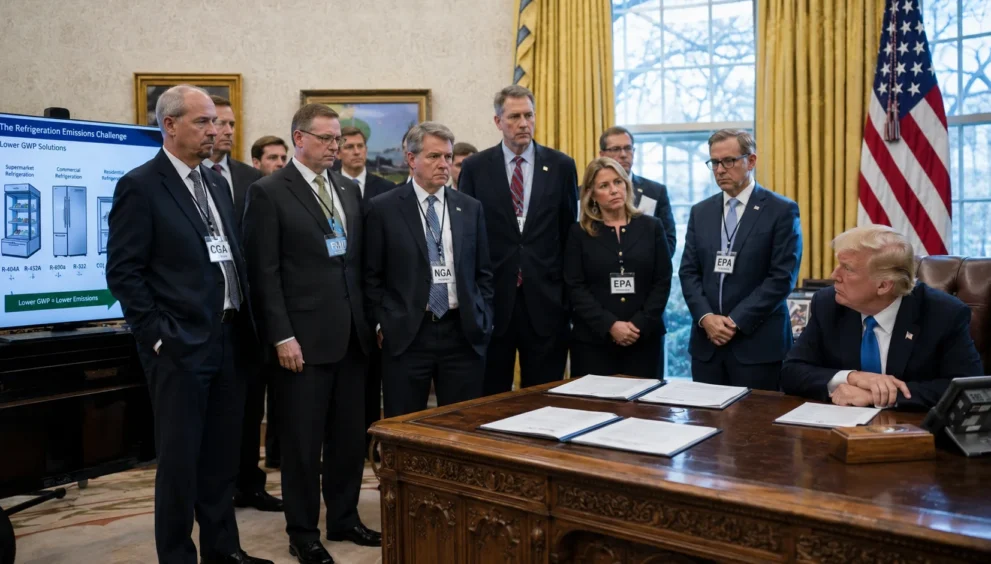
The Trump refrigerant rollback EPA power balance debate sharpened after the White House moved to extend Biden-era deadlines on hydrofluorocarbon phase-outs, a shift that reshapes how federal environmental rules interact with inflation politics. The decision affects grocery supply chains, refrigeration manufacturers, and transport logistics across the United States. It matters now because it exposes a deeper conflict between executive economic messaging and long-term regulatory enforcement.
The Question Behind the Policy Change
Why does a refrigerant rule trigger a political argument about inflation?
Because it sits at the intersection of climate regulation and consumer pricing. The EPA’s hydrofluorocarbon rules under the 2020 American Innovation and Manufacturing (AIM) Act require gradual replacement of high-emission cooling gases. On paper, that reduces environmental harm. In practice, it forces supermarkets and logistics firms to replace equipment on fixed timelines.
The Trump administration’s extension of compliance deadlines changes that timing. Not the law. The pace.
As US EPA climate enforcement and regulatory rollback analysis previously examined, enforcement speed often matters more than statutory language in determining business behavior.
What Changed in Practice
A regulatory timeline shift, not repeal
The Biden-era 2023 Technology Transitions Rule set phased reductions for hydrofluorocarbon usage in refrigeration and air conditioning systems. Those rules forced capital investment cycles across the retail and logistics sectors.
In October 2025, according to EPA briefing materials published under the current administration, enforcement windows expanded for grocery refrigeration systems and transport cooling units.
The Environmental Protection Agency, now led by Administrator Lee Zeldin, framed the adjustment as consumer relief. The Food Industry Association estimates compliance upgrades can reach $1 million per large grocery store, depending on system size and refrigerant type.
That number matters. It anchors political messaging.
Fragment. Cost becomes narrative.
External reporting from US Environmental Protection Agency official regulatory documents confirm the AIM Act still governs phase-down targets, but enforcement flexibility now sits with executive interpretation.
The Core Political Friction: Executive Power vs Regulatory State
This decision doesn’t rewrite environmental policy. It tests who controls its rhythm.
The executive branch now shapes enforcement tempo across a statute Congress passed in 2020. Courts have not intervened. Congress has not amended the framework. That leaves timing decisions inside the White House and EPA.
Dr. Kelly Sims Gallagher of Tufts University’s Fletcher School, who studies climate governance, has argued in prior regulatory reviews that “delay functions as policy even when law stays intact.” Her point applies directly here. Delay shifts investment risk. It also shifts political accountability.
Then there’s this. Grocery inflation gives the policy a second life beyond environmental law.
As inflation drivers in US supply chain systems explored, energy and logistics costs feed directly into retail pricing psychology, even when upstream regulatory costs remain marginal.
Winners, Losers, and the Pressure Points
Supermarket chains gain short-term liquidity flexibility. They avoid immediate refrigeration replacement cycles, which typically stretch over multiple years of capital planning.
Manufacturers lose predictability. The Air-Conditioning, Heating, and Refrigeration Institute warned in public comments that inconsistent deadlines disrupt refrigerant supply markets already tightening under global HFC phase-downs. Stephen Yurek, the group’s CEO, argued that delayed compliance can increase long-term service costs by distorting supply expectations.
The White House gains something different. Narrative alignment with grocery inflation concerns heading into a politically sensitive cycle.
But the transmission breaks quickly. Grocery margins sit below 3% on average, according to industry benchmarks from the National Grocers Association. That leaves little room for policy-driven price reduction, even if compliance costs shift.
So the signal travels further than the savings.
Institutional Impact: How EPA Authority Shifts in Practice
Federal environmental regulation rarely collapses in single reversals. It bends through enforcement timing.
The AIM Act remains intact. The EPA retains authority over refrigerant phase-down schedules. But by extending deadlines, the executive branch effectively reorders compliance urgency across industries.
That creates a precedent. Future administrations can now treat regulatory timing as a policy lever without reopening statutory fights in Congress.
A former Office of Management and Budget analyst described this dynamic in prior regulatory debates as “soft repeal through scheduling.” The law stands. The pressure changes.
Short sentence. Big consequence.
What It Signals Politically
The policy does not primarily target emissions. It targets affordability perception.
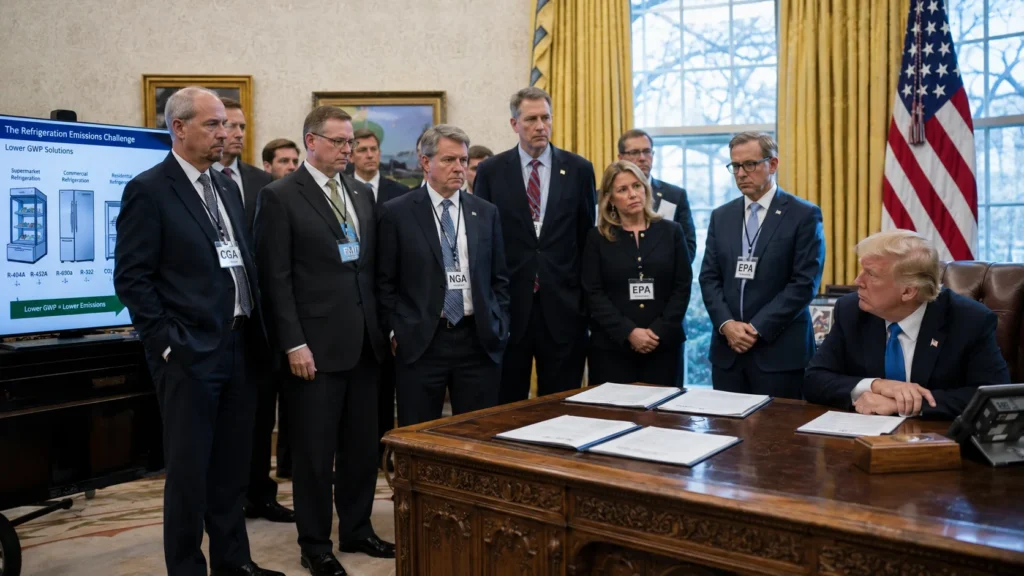
Grocery inflation remains one of the most visible economic stress points in suburban and swing districts. Retail executives appearing alongside EPA officials signals coordination between industry pressure and federal messaging strategy.
But voters don’t track refrigerant phase-down schedules. They track receipts.
That disconnect defines the political risk. And the opportunity.
Author Bio
Written by a senior policy and regulatory affairs analyst covering U.S. environmental governance, inflation policy, and executive branch decision-making across federal agencies for over 10 years.