

 English
























































































Her Family Had No Photos. She Built an Archive Anyway.
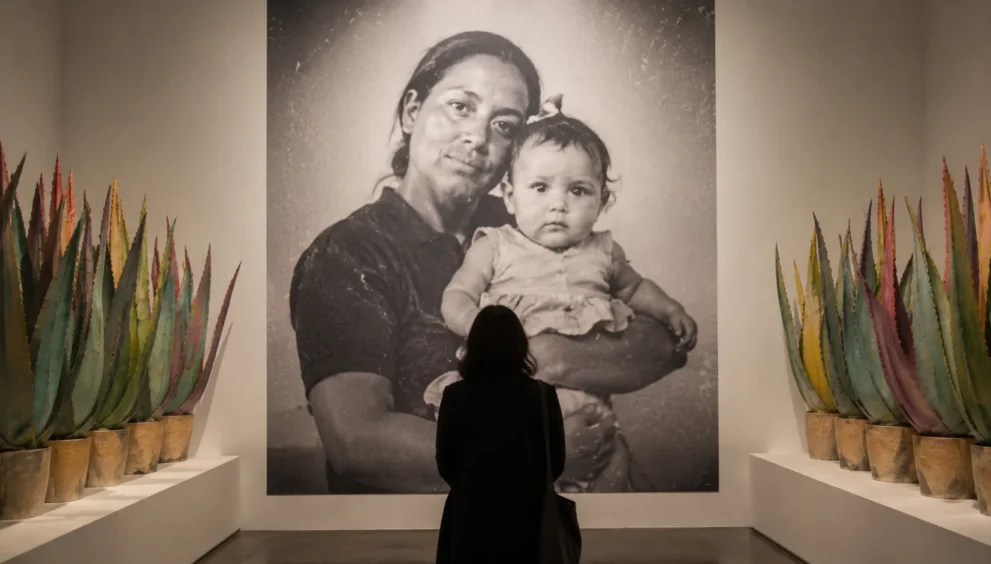
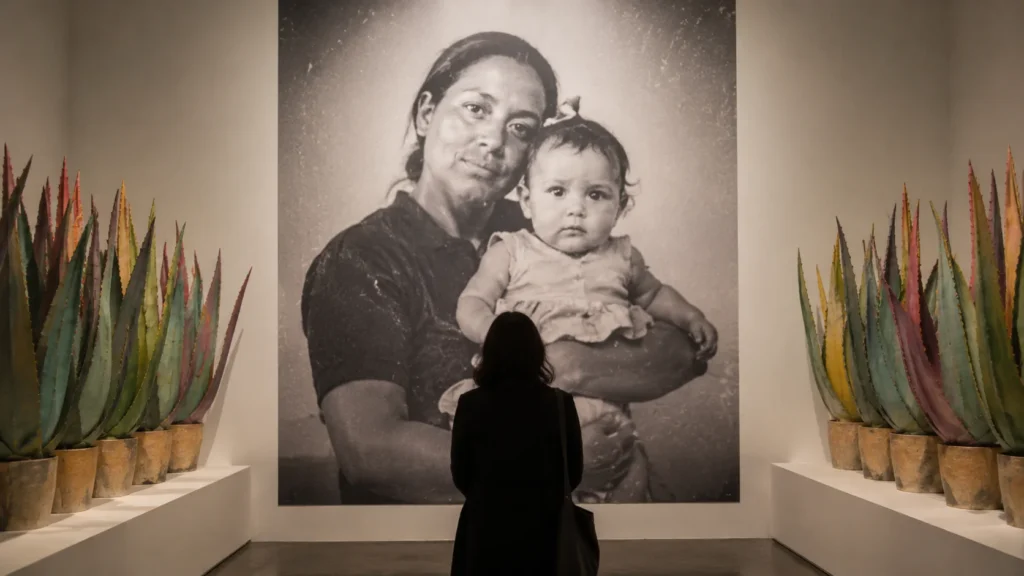
The photograph was small and grainy. A mother holding her baby daughter. Widline Cadet had never seen it before she began hunting for images of her family. She found it. She printed it wall-sized and flanked it with colourful sculptures of aloe plants. She titled it “I put all my hopes on you.” The image now functions as an altarpiece in the largest exhibition of her work to date, “Currents 40: Widline Cadet,” at the Milwaukee Art Museum.
Cadet was four when her mother left Haiti for New York. The separation lasted six years. During that time, her father travelled back and forth, carrying a small number of photographs between them. This was how Cadet learned she had a new baby sister. Photographs were not abundant. Her mother had no picture of her own mother. Memories faded with each passing year.
Now, for nearly a decade, Cadet has been building a multi-generational living archive—photographs, video, sound, sculpture—that fills the gaps the original images could not. She stages scenes without a firm sense of time or place, casts strangers as sisters, prints photographs to fold into the junctures of gallery walls, frames images in half-circles that echo a window shape from one of her grandparents’ surviving pictures. Faces turn away. Figures disappear into luminous dark. Hues vibrate with Technicolor saturation. The work is not documentary. It is not fiction. It is something in between.
So what is actually happening here? An artist who grew up with almost no visual record of her own childhood has built an archive that does not claim to be true. It claims to be adequate. The difference matters. The family photograph promises evidence. Cadet’s photographs promise something else: that the gaps can be filled with imagination when memory fails, and that the filling is itself an act of love.
The Photograph That Started Everything
Cadet’s entry into the archive began with what was missing. Her mother had no image of her own mother, who died before Cadet was born. “What would it be like if I met with my grandmother who died years before I was even born?” she asked. “Would she look like a stranger or not?”
The question is not rhetorical. It animates the work. Cadet photographs strangers as stand-ins for family members she cannot picture. She casts friends as proxies for herself. The substitutions are not deceptions. They are admissions. The record is incomplete. The imagination must supply what the camera could not capture.
She films herself asking her mother questions in Haitian Creole on a split screen—an oral history for the archive, a daughter trying to understand a woman she did not know for six formative years, then lived with for decades without fully knowing. “I think it changed my view of her as a person,” Cadet said. “She had ideas and dreams before she was married, before she had kids, and I don’t know that version of her.”
The archive is not just a record of the past. It is an intervention in the present. Cadet said her relationship with her mother is “a work in progress.” Assembling the show surfaced things. “So much has come up for me internally about my relationships with my parents and my relationships with my siblings. Honestly, that’s part of it. That’s part of the work.”
The Texture of Memory
Cadet’s photographs resist straight reading. She embeds small video screens into still images. She prints photographs to fold into the corners of gallery walls. She frames them in half-circle portals. She overlays sculptural breeze blocks—terracotta-red, like the ones she remembers from Haiti—as physical barriers between the viewer and the image behind them. A nighttime view of lush greenery sits just out of reach.
The technical choices mirror the psychological experience of remembering. Memory does not present itself in clean frames. It fragments. It folds. It blocks access to certain scenes while illuminating others with unnatural clarity. Cadet’s work reproduces that texture. You cannot see everything at once. Some parts remain hidden. Some parts glow.
Haiti is present everywhere in the work and almost nowhere. Only a few archival images and video clips show the country directly. But Cadet has found echoes of it in Los Angeles, where she moved three years ago—in the vibrant florals, in the architecture, in a set of gingham dresses that resemble her childhood school uniform worn by two girls lying on grass. She has not returned to Haiti since 2016, when her last living grandparent died. She filmed part of the wake. She did not know it would be her final visit. Her relatives there have all emigrated or passed away. Hurricane Matthew and ongoing political unrest have made the return difficult.
The work carries what the artist cannot physically reach. “I think things got more imaginative and fluid,” she said of the archive’s evolution. She began with a strict sense of taking pictures for the purpose of being archived. She ended somewhere else.
The Diasporic Archive
Cadet’s family is now spread across New York, New Jersey, and Florida. Her siblings and half-siblings experienced different periods of separation, different immigration timelines, different relationships to the places they left and the places they landed. The work has helped her understand their varied experiences, she said. “We’re very different people, but our relationships are good, weird in some ways. I think we’re still learning to be with each other.”
The learning is part of the archive. The weirdness is part of the archive. The gaps are part of the archive.
Curator Kristen Gaylord noted something paradoxical about the work’s reception. “She’s very deeply excavating her own archive, and there’s something about that specificity, almost paradoxically, that makes it more relatable to a lot of people. The stories that she tells about her family make visitors think about their own stories from their own families, and the relationships they have.”
The paradox is real. The more specific the image, the more universal the recognition. Cadet’s mother holding a baby daughter, printed large and titled with a sentence of hope, is a specific woman in a specific diaspora. She is also every mother who left one country so her children could grow up in another. The altar Cadet built for her is personal. The people standing before it in Milwaukee bring their own mothers with them.
The Work of Filling Gaps
The tension here is authenticity vs. reproduction. The family photograph is traditionally understood as evidence. This person existed. This event happened. This is what we looked like. Cadet’s archive does not make that claim. It makes a difference. This person might have existed. This event might have felt like this. This is what we might have looked like if someone had been there with a camera.
The difference is not a failure of documentation. It is a different kind of documentation—one that records not what was seen but what was lost, not what was captured but what was missed. The grandmother who died before Cadet was born, for whom no photograph exists, appears in the work as an absence. The absence is the subject. The imagination fills it. The filling is provisional. The archive remains open.
Cadet’s work joins a growing body of contemporary art that treats the archive not as a fixed repository but as a living, revisable document. The diasporic experience—migration, separation, the scattering of family across borders and languages—produces gaps in the record by its nature. People leave. Photographs are lost. Memories fade. The archive that Cadet builds does not pretend to restore what was lost. It builds something new from the pieces that remain.
What Comes Next
The Milwaukee exhibition will travel. The archive will grow. Cadet will continue adding to it—new images, new videos, new sculptures, new conversations with her mother. The work will not be resolved. It is “a work in progress,” she said. The phrase describes her relationship with her mother. It also describes the archive. The archive is the relationship, made visible.
The art world has increasingly embraced work that blurs the line between personal history and constructed image. Cadet’s practice sits at the centre of that shift. She is not alone in building an archive from fragments. She is unusual in the tenderness with which she treats the fragments themselves. The small, grainy photograph of her mother and baby sister becomes a wall-sized altarpiece. The missing grandmother becomes a question that structures the work. The gaps become the subject.