
 English












































































































Gaudí’s Church Took 100 Years. Engineers Just Changed the Rules.
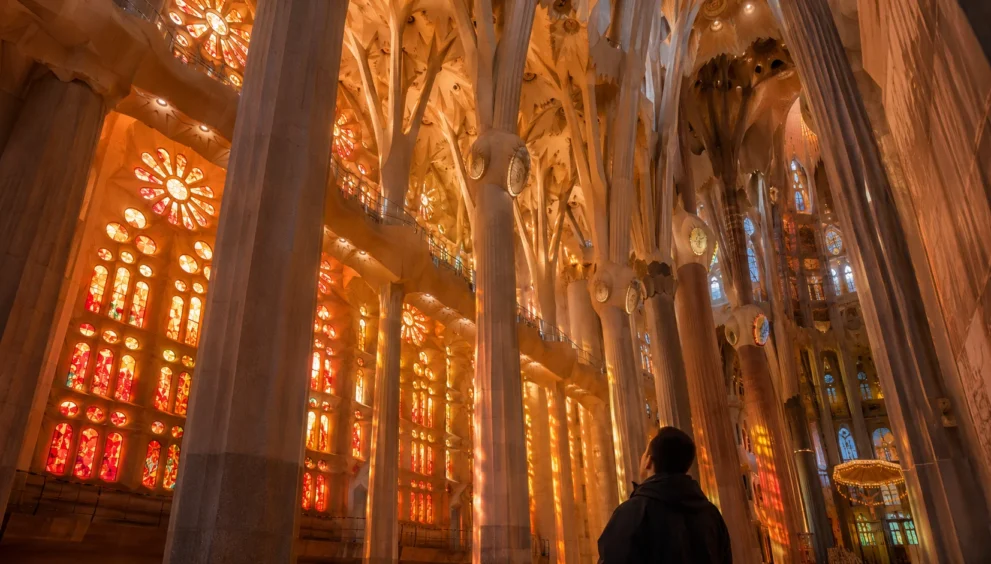
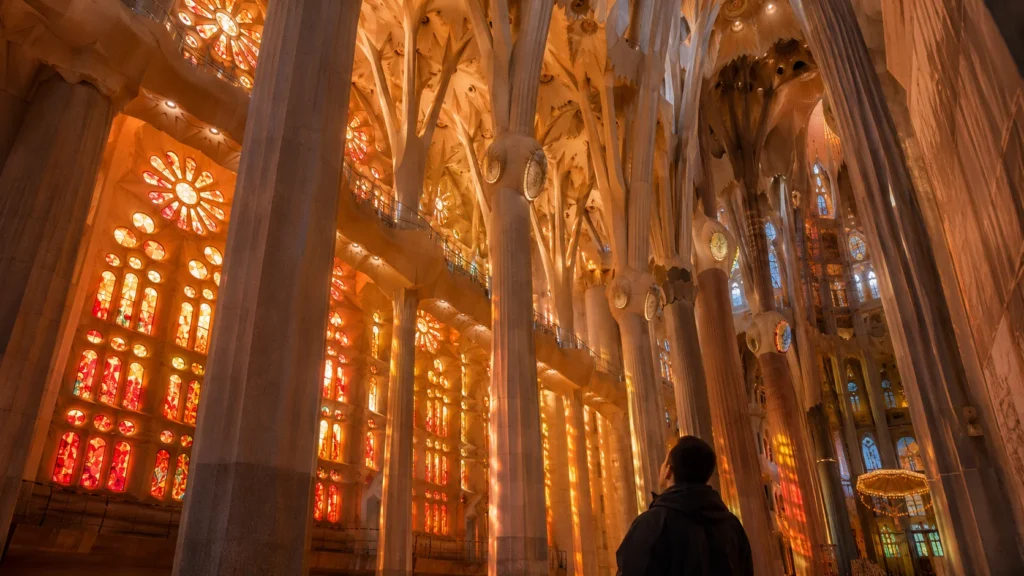
The columns do not look like columns. They branch upward like trees, splitting at angles that feel vegetal rather than architectural. Stand in the nave of Barcelona’s Sagrada Família at the right hour—oranges and reds bleeding through the western stained glass—and the weight above you seems to disappear. It does not disappear. Each tree-column carries an unimaginable pressure from the towers overhead. The illusion of weightlessness is the engineering.
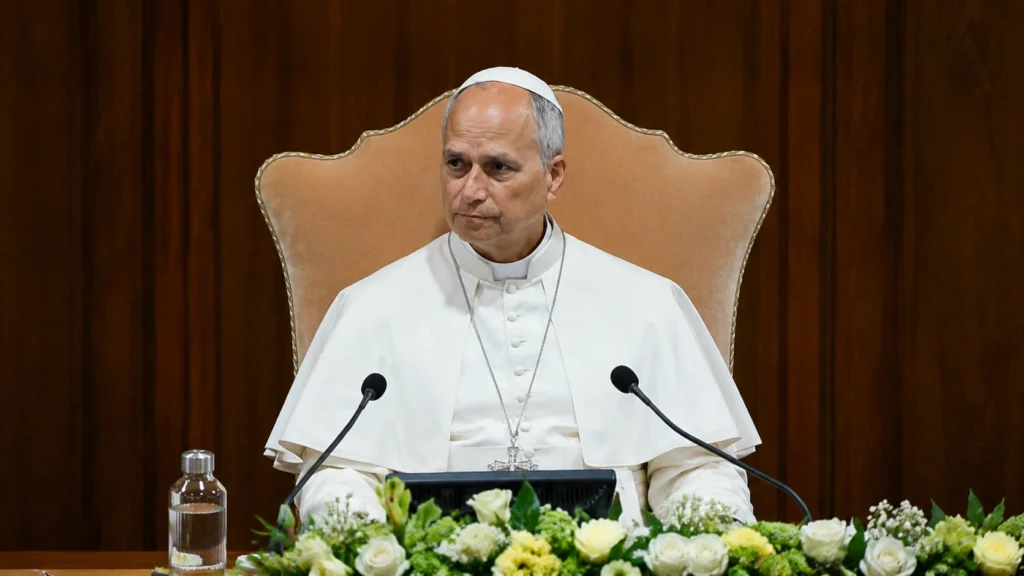
This month, 100 years after Antoni Gaudí’s death, Pope Leo XIV inaugurates the Tower of Jesus Christ. It rises to 172.5 meters, completing the central pinnacle and securing the church’s title as the tallest in the world. The ceremony marks something stranger than a completion. Gaudí never intended to finish the church in his lifetime. He intended to set a process in motion that would outlast him. Then a tram struck him on a Barcelona street in June 1926. He died in a pauper’s hospital. His sketches and models were burned in the Spanish Civil War a decade later. The process should have died with the documentation.
It did not.
So what is actually happening here? A 100-year construction project has not just continued past its author’s death. It has changed methods entirely—from stone masonry to pre-stressed panels, from human climbers surveying cracks to AI drones scanning the basilica in a single month. The question is no longer whether the Sagrada Família is Gaudí’s church. The question is what it means for a building to belong to its architect when the architect has been dead for a century.
The Arch That Made It Possible
Gaudí’s structural insight came from a photograph of an ancient ruin. The Arch of Taq-iKisra, in present-day Iraq, built between the 3rd and 6th centuries AD, remains the largest brick arch in the world. Its shape follows a catenary curve—the line a chain makes when held at both ends and allowed to fall. Invert that curve in stone, and the resulting arch carries its own weight with extraordinary stability.
“Gaudí voraciously sought out photographs of ancient wonders like this arch,” says Gijs van Hensbergen, an art historian and Gaudí biographer. “It’s impossible that he wouldn’t want to create a new wonder of the world.”
The catenary arch gave Gaudí what he needed to eliminate flying buttresses—those stone fingers reaching outward from Gothic cathedrals to brace the walls. He considered them “crutches,” a sign that the building could not hold itself up. His church would need no crutches. The tree-columns branching through the nave compress under the load. The shape does the work.
“He used catenaries to help him come up with the most efficient forms,” says Liam Duff, a structural engineer at Arup who leads a team working on the basilica. Efficiency was theological for Gaudí. Gravity was divine. The curve that distributed force most economically was God’s curve. Engineering and worship occupied the same gesture.
The Tower That Was Too Heavy
The Tower of the Virgin Mary, at 138 meters, the second-tallest structure on the site, posed a problem that Gaudí’s original methods could not solve. Traditional masonry or reinforced concrete with stone facing would overload the columns beneath it. The tower was simply too heavy for its own foundations.
Arup’s engineers proposed something radical: abandon the steel frame and reinforced concrete entirely. Instead, use thin stone panels stressed with internal steel tendons—a technique called pre-stressed stone. The tendons compress the panels so tightly that when the wind pulls the tower into tension, the stone does not crack.
“That was a very big shift,” says Steve McKechnie, a structural engineer at Arup who joined the project in 2014. “There was a time when we thought our services weren’t going to be required, and the project went very quiet.” The pause was theological as much as technical. Did pre-stressed stone panels belong in Gaudí’s church? Were the engineers completing his vision or replacing it?
The Tower of the Virgin Mary rose. Then five other central towers followed, including the Tower of Jesus Christ. Since 2014, the method has spread through the construction. The builders now use drones and artificial intelligence to survey cracks that human climbers once spent two years cataloguing. “Once we have the AI trained, it will be possible to scan all the basilica in one month,” says Fernando Villa, the basilica’s director of technology and innovation.
The pace has shifted. The methods have shifted. The question of authorship lingers.
What Gaudí Would Have Wanted
Van Hensbergen believes Gaudí “would have been really excited by the possibilities.” The evidence sits on the Tower of Saint Barnabas, completed during the architect’s lifetime. He began at the bottom with Montjuïc sandstone, which shifts in color from grey to beige, green, ochre, gold, purple, and red. By the top, he was using Portland cement—a new material in Barcelona at the time.
“He was already experimenting and seeing new technologies arriving,” says Duff. Villa describes the tip of that tower as “perfect” after 100 years. The experimentation was not a concession to modernity. It was a principle. Nature, Gaudí believed, was his teacher. Nature does not preserve methods. It adapts.
The church itself adapts. Villa describes it not as a fixed monument but as something that responds to wind, temperature, and the slow movement of stone over time, almost like a living thing. Cracks appear. Drones find them. AI catalogues them. The building breathes in a cycle of stress and repair that its architect could not have predicted and might have recognized.
The Canon Problem
The tension here is Tradition vs Innovation—but not in the sense of old methods versus new. The real question is authorship. Who gets credit for a building that took a century, outlived its creator, and required technologies he never touched?
The Sagrada Família complicates the romantic idea of the solitary genius. Gaudí set the parameters. The catenary arch, the branching columns, the rejection of flying buttresses, the insistence on natural light through windows that made the pre-stressed panels harder to engineer—all of that is his. The pre-stressed panels themselves, the AI survey drones, the accelerated construction timeline: none of that is. The building is the product of a system Gaudí designed, not a blueprint he left.
This matters beyond Barcelona. The Sagrada Família is the most visible example of a problem that will become more common as long-duration projects outlast their originators. Architecture has always dealt with completion after death. The Sagrada Família raises the stakes because the completion required such a fundamental shift in technique. The engineers did not just execute Gaudí’s plan. They redesigned parts of it to make it possible. The line between fidelity and revision blurs with every pre-stressed panel.
What Comes Next
The Glory Façade, the church’s main front, remains unfinished. Work continues. The construction timeline, once measured in generations, now operates on a faster clock. The drones and AI that survey cracks will become standard tools for maintaining monumental architecture. Other long-duration projects will study the Sagrada Família’s pre-stressed stone panels. The method works. It will spread.
The deeper shift is conceptual. The Sagrada Família proves that a building can change hands, change methods, change technologies, and still claim continuity with its origin. The claim depends on whether you believe the essence of the building is its form or its principles. Gaudí’s form is everywhere—in the tree-columns, the catenary curves, the light bleeding through stained glass. His principles are harder to pin down: experiment, observe nature, use gravity as a partner rather than an enemy. The engineers who finished the Tower of Jesus Christ honored the form. The principles they honored by adapting them.