

 English










































































































































































































































































































































More Than 65,000 Evacuated as Wildfires Rage Across France and Spain
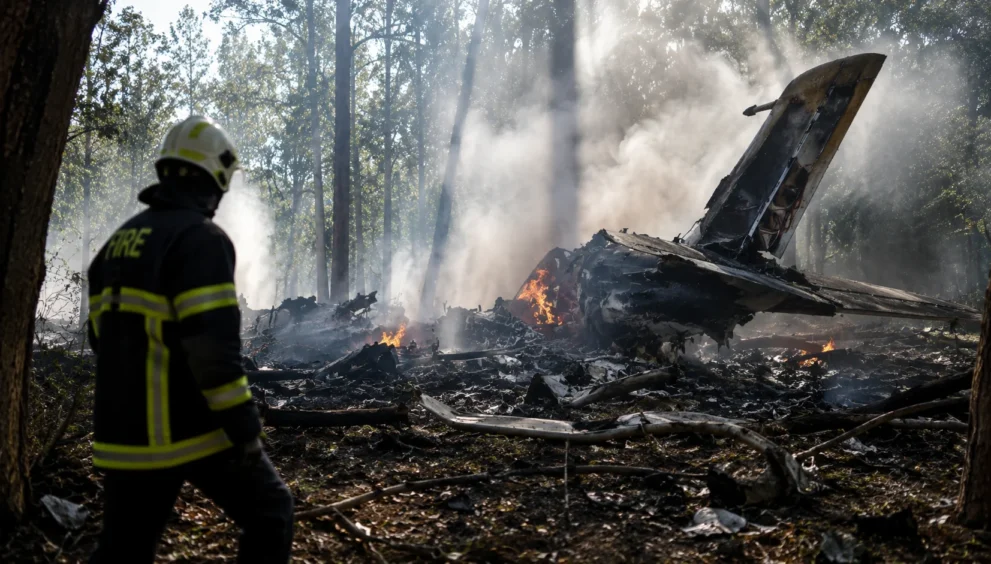
More than 65,000 people have been evacuated across Spain and France as significant wildfires continue to burn on the continent, fuelled by the third heatwave of the summer. Approximately 25,000 people have been evacuated in Spain and another 20,000 are in lockdown, with the Madrid region experiencing what its president called “the worst fire in the history of the region.” In south-west France, more than 44,000 people have been forced to flee over the past two days, including the entirety of the Cap Ferret peninsula. A firefighter has died tackling a wildfire in Sicily.
Two fires merged on the outskirts of Madrid on Friday, with authorities concerned that a third could also merge. Spanish Prime Minister Pedro Sánchez said people were “living through a dramatic situation.” French Interior Minister Laurent Nuñez said 40,000 people had been evacuated from the Gironde region and 23,000 from Landes. The fires are the product of extreme heat, relentless winds, and an abundance of dry vegetation following a wet winter and sunny spring.
The Situation in Spain
Madrid’s regional president, Isabel Díaz Ayuso, described the fires as “the worst fire in the history of the region” and a “completely unusual and catastrophic” situation. Speaking at an emergency command post in the south-western municipality of Cenicientos, she said the area was facing a “perfect storm” of high temperatures, relentless wind, and several fire fronts merging.
Two fires merged on the outskirts of Madrid on Friday. Authorities feared a third could join them. North of the capital, in the Ávila region, wildfires have scorched 9,000 hectares. The Spanish government declared a national emergency for the Madrid region and neighbouring Ávila province on Thursday, which allows additional resources to be deployed at speed.
Approximately 25,000 people have been evacuated and more than 20,000 are in lockdown, according to Francisco Martín, the delegate of the government in the Community of Madrid. The towns of Fresnedillas de la Oliva and Robledo de Chavela were ordered to evacuate on Friday, adding approximately 7,000 more people to the displaced. Dozens of helicopters, amphibious vessels, and forest brigades have been deployed.
Ecologio Cabrera, 86, was forced to flee his village of Aldea del Fresno west of Madrid. His family had been spraying their house with garden hoses, trying to save it, when firefighters arrived and ordered everyone to leave. “If you don’t run from it and you try to face it, it devours you,” he told AFP from a sports hall in Vilamanta, where hundreds of evacuees have sought refuge. “I have never experienced anything like this.”
According to Spanish government emergency declarations and regional president Isabel Díaz Ayuso’s statements on the Madrid fires, the situation remains critical with multiple fire fronts still active.
As our coverage of Europe’s worsening wildfire seasons and the strain on emergency response systems has documented, the continent is experiencing fires that are increasing in frequency and intensity.
The Situation in France
The entirety of the Cap Ferret peninsula on France’s south-west coast was ordered to evacuate due to a fire that local prefect Sophie Brocas called an “XXL fire.” The blaze has destroyed 12,500 hectares—nearly 31,000 acres—as well as 53 homes and a campsite. It began on Tuesday and was still burning on Friday.
French Interior Minister Laurent Nuñez said 40,000 people had either been evacuated or were in the process of being evacuated from the Gironde region. The municipalities of Sainte-Hélène, Salaunes, and Lanton were ordered to undergo preventative evacuation on Friday, in addition to the Cap Ferret peninsula and the districts of Arès, Andernos, Le Temple, and Saumos.
Further down the coast, near the town of Biscarrosse in the Landes region, another major fire began on Thursday afternoon. Landes prefect Gilles Clavreul said approximately 23,000 people were evacuated between Thursday afternoon and Friday morning, with another 8,000 expected to be moved from Parentis-en-Born. About 18,000 people in Biscarrosse and 5,000 in Parentis-en-Born had to leave their homes, campsites, a nursing home, and a summer camp.
Five hundred firefighters have been deployed in Landes, with five injured but not severely. Approximately 105 properties have been affected or destroyed. Clavreul said weather developments were “not really favourable,” with winds of up to 50km/h (31mph) and temperatures of 36-37C. Some rain is expected, but there have not currently been any victims reported in the civilian population.
According to French government statements from Gironde prefect Sophie Brocas, Landes prefect Gilles Clavreul, and Interior Minister Laurent Nuñez on the evacuation operations, the fires are among the most significant in recent French history.
The Climate Context
The fires are being driven by the third heatwave of the summer in Europe. BBC Weather reports that Sardinia recorded temperatures above 47C. The continent is warming twice as fast as the global average, according to the Copernicus climate service.
A wet winter followed by a sunny spring created optimal conditions for vegetation growth across western Europe. The recent hot and dry weather has dried out this vegetation, providing a large amount of fuel for fires. Some relief is expected over the weekend as cold fronts bring showers and thunderstorms, initially across northern Spain and Portugal before spreading across southern France and the western Alps. However, the structural conditions for fires will persist.
In Italy, a firefighter died tackling a wildfire in Sicily, and thousands of emergency responders have been working to contain fires across the country.
As our analysis of climate change and the increasing frequency of European heatwaves and wildfires has tracked, the interval between major fire events is shrinking, and the resources required to manage them are growing.
FAQ
How many people have been evacuated?
More than 65,000 across Spain and France. Approximately 25,000 in Spain with 20,000 more in lockdown. More than 44,000 in France, including the entire Cap Ferret peninsula.
Where are the fires burning?
In Spain, the largest fires are west of Madrid in the Madrid region and neighbouring Ávila province. In France, fires are burning in the Gironde region on the Cap Ferret peninsula and in the Landes region near Biscarrosse. Fires are also burning in Italy, including Sicily.
What is causing the fires?
A combination of extreme heat, strong winds, and an abundance of dry vegetation. Europe is experiencing its third heatwave of the summer. A wet winter and sunny spring produced significant vegetation growth, which has since dried out.
Has anyone died?
A firefighter has died tackling a wildfire in Sicily. Five firefighters have been injured in France. There have been no civilian deaths reported so far.