

 English






















































































































































































The Bond Game Recorded at Abbey Road. The Music Was Real.
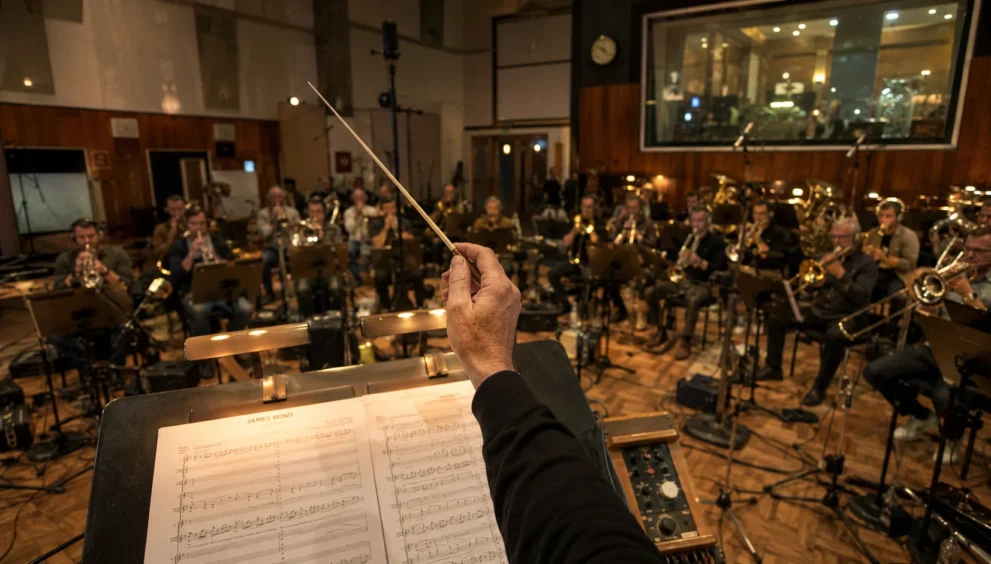
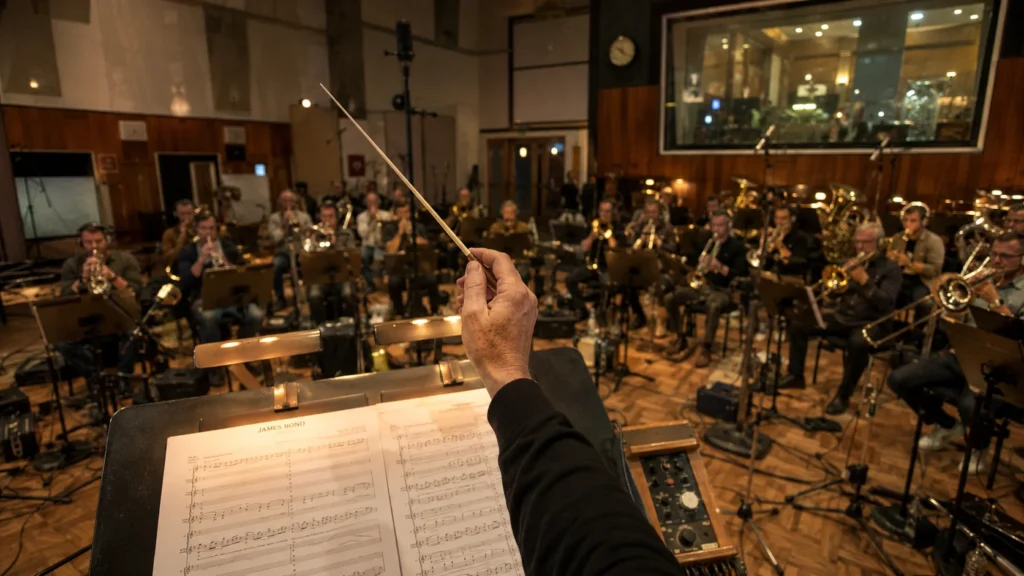
“Save your lips, because they are a finite resource.” Conductor Matt Dunkley addressed the London Chamber Orchestra’s brass section at Abbey Road in November 2025. The session had one half-day to record 32 minutes of music. Four hours of non-stop puffing and blowing. The composers—Alexis Smith and Joe Henderson, who work under the name The Flight—had spent two years writing the score for 007 First Light, the new James Bond video game, in their cramped east London studio. They had built it with software orchestral instruments, mocking up the sound of brass, strings, and percussion on computers. “The things you can do with software orchestral instruments nowadays are amazing,” Smith said. “We absolutely need that as we’re mocking things up, but then you come here, and you have the best brass players in the world… It’s mind-blowing.”
The session was the moment the simulation met the real. The software had been a sketch. The musicians were the painting. The difference was the thing that cannot be programmed: 24 people in a room, breathing into metal, exhausting themselves, making mistakes on the first take and perfection on the second. “My least favourite thing in music exams was sight-reading,” Smith said, “so these guys are just amazing. They need one take to get the feel, and the second take sounds perfect.”
By the end of the day, everyone was wrung out. “We had to do a lot of music very quickly, so we’re tired and emotional,” Henderson said. “But the band was incredible.” The fatigue was the evidence. Software does not get tired. Software does not need to be asked to do one more take “while there’s still blood left in your top lip.” The exhaustion was the guarantee that what had been recorded was real.
This is not an isolated event. This is a structural shift in how cultural heritage is transmitted—not from human to human, but from human to software to human again. The Bond franchise, one of the most carefully preserved cultural properties in the world, has entered a medium where the music is the only thing that is actually real. The game is digital. The action is simulated. The orchestra is not.
The Franchise That Changed Hands
First Light was the last Bond project supervised by Barbara Broccoli and Michael G Wilson before they gave creative control to Amazon MGM Studios. The handover arrived in the middle of production. “The email chains all changed overnight,” Henderson remembered. The composers briefly worried the project was in jeopardy. “It reminded us what a big deal James Bond is—because that news was everywhere,” Smith said. “My family would see that in the newspaper and go, ‘Oh, is your game still all right?’ That doesn’t happen when you’re working on other game franchises.”
Bond is not like other franchises. It is a custodial property. The people who control it are stewards of something that predates them and will outlast them. The Broccoli family held that stewardship for decades. Amazon now holds it. The transition from family ownership to corporate ownership is the kind of moment that cultural historians will study—the point at which a carefully managed legacy passes from the hands that built it to the algorithms that will exploit it.
The game arrived during this transition as a bridge object. It was conceived under the old regime and completed under the new one. The music was recorded at Abbey Road, the studio where the Beatles built their catalogue and where John Barry conducted the early Bond scores. The location was not accidental. It was an assertion of continuity. The franchise had changed owners. The music had not changed rooms.
The Interactive Score
Video game music differs from film music in one fundamental way. A film score is linear. The action happens in a fixed sequence. The music follows it. A game score is branching. “You may be sneaking around, you may be being chased, you may be fighting,” Smith explained. “And the music that you hear depends on how well you’re doing as a player.” Henderson added: “If you’ve finished the fight because you’ve achieved all your objectives, it’ll be a different ending than if you just run away.”
The structure requires the composers to anticipate multiple futures. The player’s choices determine which version of the score plays. The music is not composed as a single narrative arc but as a set of possibilities. The orchestra records all of them. The software assembles them in real time. The human performance is fixed. The digital playback is fluid. The combination is the form.
The Flight had permission to use classic Bond motifs, including John Barry’s theme from On Her Majesty’s Secret Service. “We were very lucky,” Henderson said, “because trying to write a new theme or a pastiche is never going to be as cool.” Smith agreed: “The main James Bond theme is one of those things that everybody knows. You couldn’t do a sound-alike of that. It would be terrible.”
The permission to use the original themes is a form of cultural transmission. The music passes from Barry to The Flight to the London Chamber Orchestra to the player. Each stage filters the material through a different medium. Barry composed for film. The Flight composed of software. The orchestra recorded for both. The player hears the result as part of an interactive experience. The lineage is continuous. The delivery mechanism has changed entirely.
The Real Thing
The Abbey Road session was not strictly necessary. Software orchestral instruments can now produce brass sounds that most listeners cannot distinguish from real brass. The technology has advanced far enough that the marginal gain of hiring 24 musicians for a half-day session is aesthetic, not functional. The game would sound fine without them. The composers chose to hire them anyway.
The choice was economic as much as artistic. A game that sells three million copies can afford an orchestra. A game that sells 30,000 cannot. The Bond franchise operates at a scale that permits the real thing. The permission is a luxury. The luxury is a signal. The signal says: ” This is not just a game. This is a Bond game. The music must be real because Bond is real, even when the medium is not.
The paradox is that the music is the only real element of the experience. The action is computer-generated. The environments are digital. Patrick Gibson’s voice performance is captured and processed. The orchestra is the sole component that exists in a physical room, produced by human breath and muscle, recorded on equipment that captures the actual vibration of air. “It’s funny,” Smith said, “because on a computer game, often the only thing that’s actually real is the music.”
Who Gains, Who Loses
The power recalibration is visible across multiple axes.
Amazon gains a franchise with a musical lineage it can continue to exploit. The Abbey Road session demonstrates that the new owners understand the symbolic value of continuity. The question is whether they will continue to invest in it, or whether the economics of game production will eventually push the scores toward fully synthetic orchestration.
The Flight gains the prestige of having composed for Bond at the exact moment the franchise changed hands. Their names will be attached to the transitional object. The career benefit is significant. The pressure was real: “Even if you’re going to have something like this, which is a new angle on the franchise, it’s still got to live with all those other great scores as well,” Smith said.
The London Chamber Orchestra gains a day’s work and a place in the Bond lineage. The players who recorded the brass parts are now part of the franchise’s musical history. The exhaustion they felt at the end of the session is the physical trace of that contribution. Software does not leave physical traces.
The audience gains a score that sounds real because it is real. The distinction may be lost on most players. It is not lost on the composers, the musicians, or the franchise’s custodians. The real thing costs more. The cost is the point.
The 24-Month Trajectory
The success of First Light—three million copies sold—will produce sequels. The sequels will face the same choice: real orchestra or software simulation. The decision will signal Amazon’s commitment to the franchise’s production values. If the orchestra returns, the tradition holds. If it does not, the economics of game production will have overruled the aesthetics of Bond music. The Abbey Road session will become either the first of many or a singular moment when the old way was honoured before it was replaced.
The broader trajectory for game music is toward software. The technology improves every year. The number of players who can distinguish real brass from synthetic brass shrinks. The economic logic points toward the synthetic. The cultural logic, for franchises with the resources to resist it, points toward the real. Bond has the resources. The question is whether it will continue to use them.