

 English





























































































































Dua Lipa’s Wedding Gave Palermo €268M. The Protesters Weren’t Impressed.
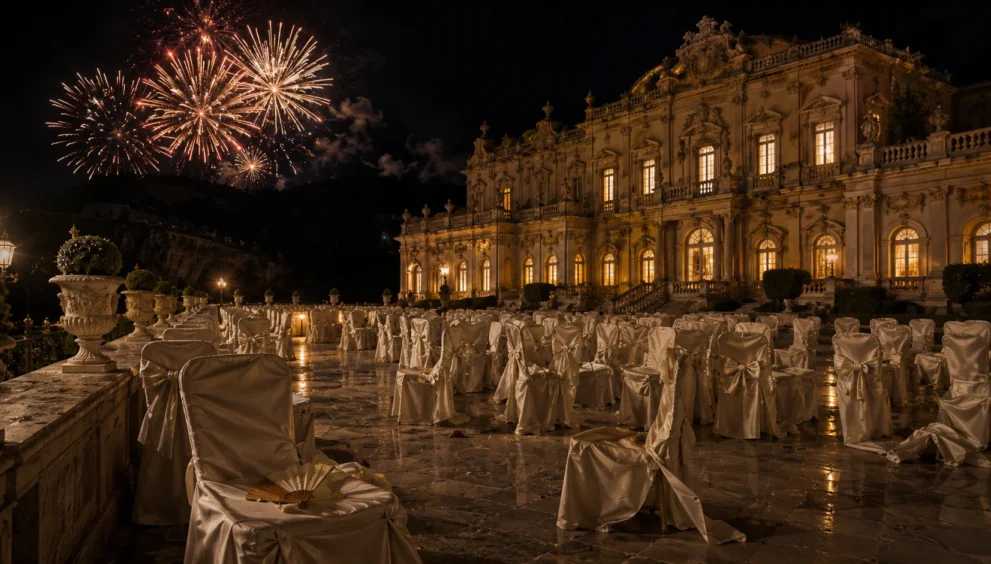
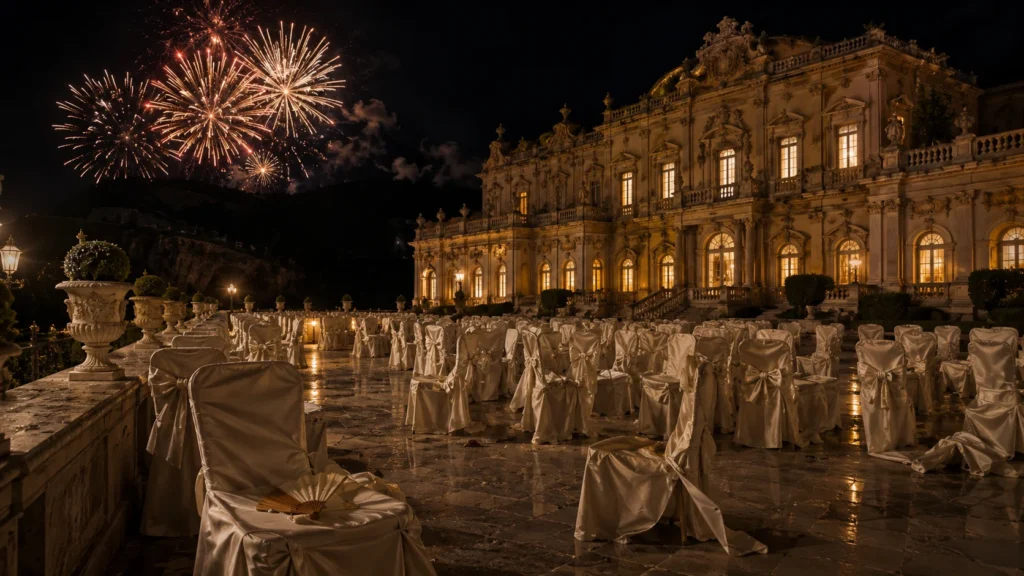
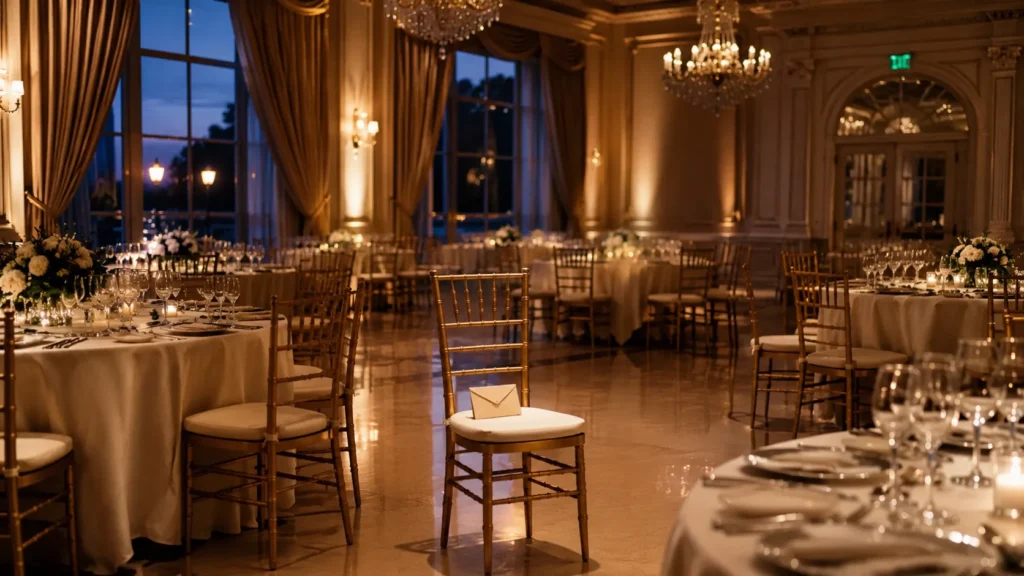
The fireworks detonated above Villa Valguarnera just after midnight. Visible across Palermo. Carl Cox, Martin Garrix, David Guetta, and Peggy Gou played past the villa’s standard curfew. Elton John had already serenaded the couple with “Your Song.” The 18th-century palace—once a mafia hideout, now owned by a writer-princess who translated Tolkien and counts Mick Jagger in her inner circle—held hundreds of guests in its monumental gardens. Each chair wore a satin bow. Each place setting held a handmade fan. Each embroidered handkerchief read “stay mad with me forever.”
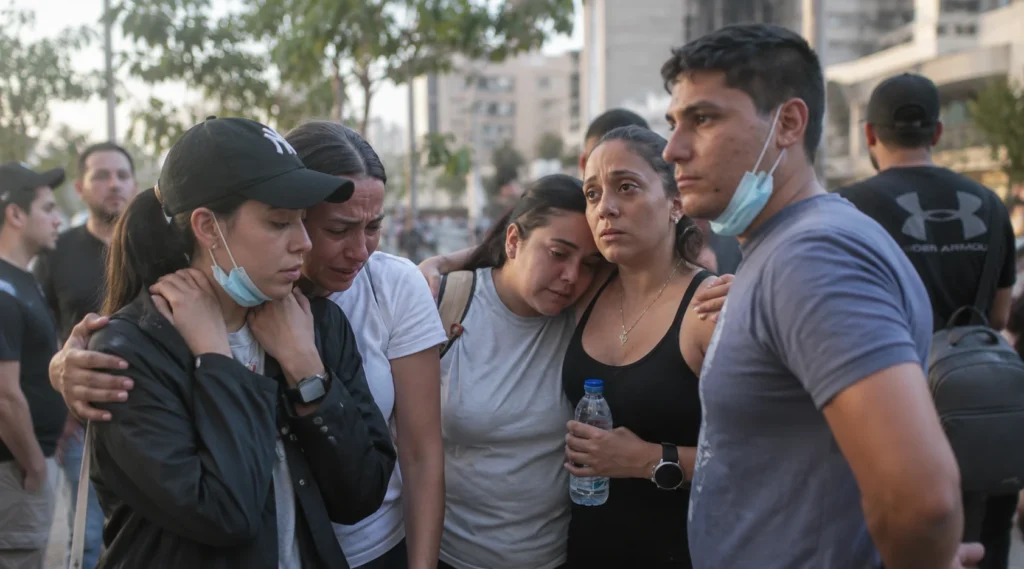
A few streets away, protesters held signs. “Palermo is not for the rich.” “Palermo is not for rent.”
The same group had demonstrated against Jeff Bezos and Lauren Sánchez’s wedding in Venice last summer. Their presence in Sicily completed a rhythm now familiar enough to be ritual: the celebrity wedding as economic event, the local protest as counterprogramming, the mayor’s office calculating the spread between visibility and grievance.
The fireworks were beautiful. The signs were legible. Both were part of the same production.
But beneath the surface, something else was happening. The wedding was not just a party. It was a test case for what happens when a city bets its identity on being chosen by people who can afford to leave whenever they want.
The €268 Million Question
The JFC research institute, cited by Italian news agency ANSA, estimated the wedding’s economic impact on the Palermo metro area at €268 million—roughly $307.7 million. The number is precise enough to sound official, large enough to function as rhetoric. Mayor Roberto Lagalla deployed it directly: “There is a clear return that leaves a lasting impression.”
He also acknowledged the inconvenience. “I’m sorry if anyone will have to face temporary restrictions,” he told La Repubblica. Then he pivoted to the image boost, the international visibility, the “widespread economic benefits.”
The mayor’s logic is not new. Cities host mega-events—Olympics, World Cups, celebrity weddings—on the promise that visibility converts into investment, that investment converts into infrastructure, that infrastructure outlasts the party. Sometimes it does. Sometimes the party ends, and the infrastructure is just fireworks.
Palermo’s calculation carries specific weight. The Villa Valguarnera sat in ruin for decades, occupied by the mafia until an urban renewal plan reclaimed it in 2020. The villa’s appearance in “The White Lotus” season two opening credits already tethered it to global pop culture. Lipa and Turner’s wedding extends that tether. The question is whether the tether pulls anything tangible behind it.
The Protest That Came Standard
The demonstrators who gathered ahead of the Friday street party did not interrupt the proceedings. They made their signs. They registered their presence. They understood their role in the pageantry as clearly as the wedding planners understood theirs.
Their signs echoed the Venice protests against Bezos and Sánchez. The language travels. “Not for the rich.” “Not for rent.” The accusation is not against the couple specifically. It is against the transaction—the sense that cities become backdrops, that public space becomes a private venue, that the economic benefits Lagalla cites do not distribute evenly enough to justify the temporary restrictions he apologized for.
The protesters’ grievance is structural. Celebrity weddings in historic city centers require street closures, security perimeters, and the temporary privatization of spaces that belong, in theory, to everyone. The €268 million figure aggregates spending across hotels, restaurants, vendors, and services. It does not disaggregate who receives it. The Michelin chefs and the Rocco Forte property and the Galleria d’Arte Moderna rental at €10,000 for the evening capture one tier of benefit. The smaller vendors, the hourly workers, the residents navigating detours—their calculus is harder to read from the mayor’s press release.
The Details That Built the Story
The wedding’s texture was legible to anyone who follows celebrity culture as a genre. Lipa wore a white leather woven Bottega Veneta dress with ostrich feathers for the Friday street party after marrying Turner in a Schiaparelli skirt suit at Old Marylebone Town Hall in London on May 31. The Friday event transformed Croce dei Vespri square into a vintage bookstore—a nod, Italian media reported, to the couple meeting while reading the same novel. Guests received gold bracelets with microchips granting access to various venues, including a private tour of the Galleria d’Arte Moderna.
The Saturday ceremony moved to the Palazzo Valguarnera-Gangi, whose ballroom appeared in Luchino Visconti’s 1963 film “The Leopard.” The reference was not accidental. “The Leopard” is a film about aristocracy confronting change—about whether old orders can survive the arrival of new forces. Holding a wedding in that room, after a street party in a square transformed into a bookstore, after a civil ceremony in London, is a kind of curation. The references accumulate. They create a story that feels authored.
Charli XCX attended. Donatella Versace attended. Elton John performed. The DJ lineup—Cox, Garrix, Guetta, Gou—doubled as a festival bill. Local media compared the event to Michael Corleone’s wedding in “The Godfather,” a comparison that flatters Palermo by equating it with cinema history while quietly acknowledging the mafia subtext that the Villa Valguarnera’s history already supplied.
One detail escaped the careful staging: Lipa’s mother, Anesa Rexha, reportedly lost a pair of shoes. They remain unaccounted for. The imperfection humanizes the production. Even the most orchestrated events lose track of something.
The Power Shift
Dua Lipa and Callum Turner gain something beyond a wedding weekend. They gain narrative authorship. The civil ceremony was private. The London legalities were quiet. The Sicilian celebration was public but controlled—a curated experience designed to generate specific images, specific headlines, specific associations. The microchipped bracelets, the vintage bookstore homage, the Visconti ballroom: each detail communicates taste, intentionality, a fluency in cultural reference that doubles as personal branding.
Palermo gains visibility. The mayor’s calculation is not wrong on its own terms. International coverage of a celebrity wedding generates attention that no municipal tourism budget could purchase. The risk is that the visibility attaches to the couple, not the city—that Palermo becomes a backdrop in someone else’s story rather than a destination in its own right.
The protesters gain a platform they would not otherwise have. Celebrity weddings attract media. The media captures the protest. The signs travel further than the demonstrators could carry them alone. The transaction is reciprocal even when it is adversarial.
What Changes Now
The wedding’s economic impact will be debated in terms that are impossible to resolve. The €268 million figure will be cited by proponents of hosting large-scale events. Critics will note that such estimates are commissioned by interested parties and rarely audited. The truth will sit somewhere inaccessible, in the aggregate of hotel receipts and restaurant tabs and vendor contracts that no one will ever sum accurately.
The protest movement that formed in Venice and traveled to Palermo will find another wedding to picket. The signs will adapt to the next city, the next couple, the next mayor, calculating the trade-off between visibility and grievance. The ritual is now established. The choreography is known.
The only unaccounted variable is Dua Lipa’s mother’s shoes. Some mysteries persist. Some details escape the curation. The most orchestrated productions leave room for something unplanned.