

 English


































































































































































































































































































































Ten Million Bats Fill the Sky. Only 800 People Come.
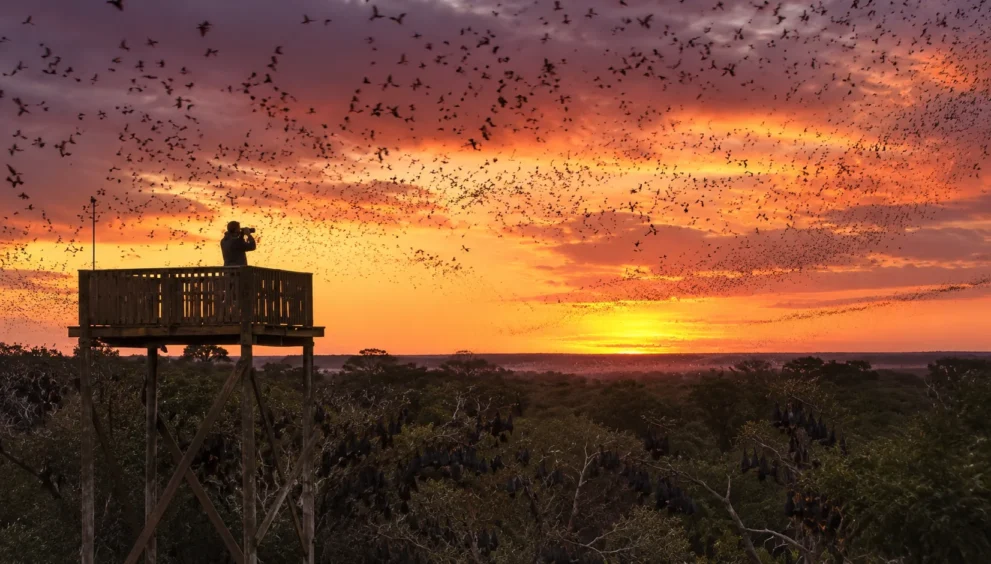
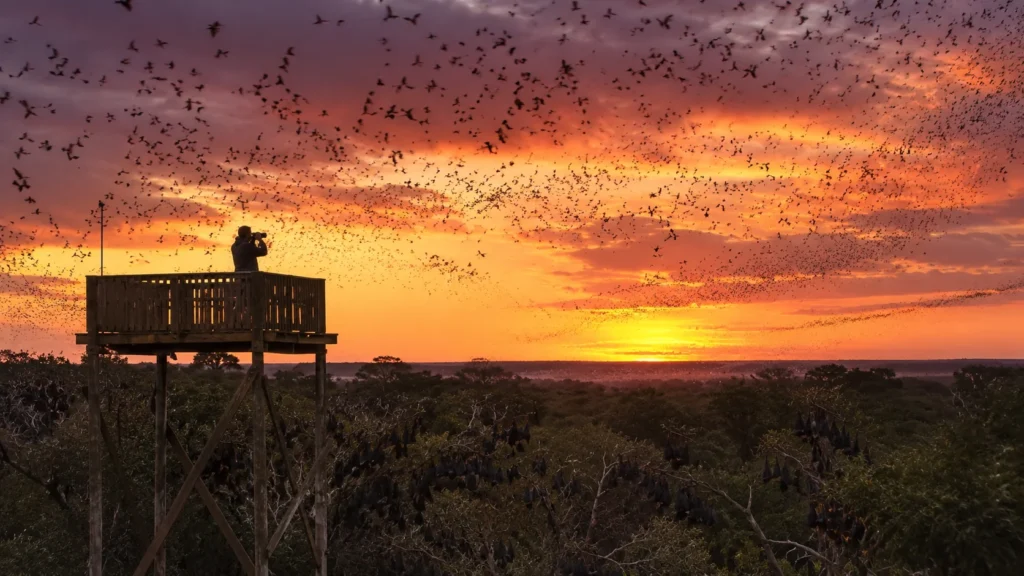
The ladder sways. The wooden platform sits 10 meters above the forest floor. Below, the miombo woodland trembles—not from wind, but from the weight of millions of straw-coloured fruit bats packed so tightly in the branches that some cling to each other rather than to the trees. The sun sets over Kasanka National Park in central Zambia. Lightning flickers on the horizon. The bats begin to fly.
At first, a few. Then more. Then the sky becomes a vortex. They stream out of the forest in every direction, swirling and tumbling like smoke in an updraft. The air vibrates with the beating of wings. An estimated eight to ten million bats—the largest mammal migration on Earth—are leaving the roost to feed. They will consume roughly 230 to 250 tonnes of fruit tonight, each bat eating its own body weight before returning at dawn. Some will travel up to 96 kilometres in a single night. One, tagged by researchers and named Hercules, once flew more than 2,400 kilometres.
Between 500,000 and 700,000 people visit the Serengeti-Maasai Mara migrations each year. Kasanka gets about 800. The Serengeti has vast plains, prides of lions, and convoys of safari vehicles. Kasanka has wetlands, papyrus swamps, a handful of traditional safari animals, and the largest mammal migration on the planet. The two numbers—half a million versus 800—do not describe a difference in spectacle. They describe a difference in infrastructure, in marketing, in the global travel industry’s idea of what counts as worth seeing.
But the visitor numbers weren’t the story. The story was Mass Market Scale vs Boutique Differentiation—and what happens when one of the greatest wildlife spectacles on Earth remains almost entirely unknown because the industry has not built a product around it.
The Park That Almost Disappeared
Kasanka is one of Zambia’s smallest national parks, roughly 390 square kilometres tucked away near the border with the Democratic Republic of Congo. By the late 1980s, poaching had emptied much of it. The park risked losing its protected status entirely. In 1990, David Lloyd, a former British colonial officer, took over its management, using his own money to build roads, bridges, and seasonal camps. Populations of puku, bushbuck, and sable antelope have since recovered. Elephants have returned. The park now holds an estimated 500 to 1,000 sitatunga—Africa’s only truly amphibious antelope, and one of the continent’s shiest creatures. More than 450 bird species have been recorded.
The recovery was not driven by tourism revenue. It was driven by a single trust, a handful of donors, and the belief that a small park in central Zambia was worth saving for reasons that had nothing to do with visitor numbers. The bats, which arrive each year from late October to December, drawn by a seasonal explosion of fruit, are the park’s most extraordinary inhabitants. They are also its least monetised.
The infrastructure reflects this. Wasa Lodge, the main accommodation, is a fully catered lakeside lodge run by the Kasanka Trust. There are campsites. There are guided walks, canoe trips, and two wooden hides—one for the bats, one for the sitatunga. There are no luxury lodges. There are no traffic jams around leopard sightings. There is no guarantee of postcard-perfect wildlife moments. There is, instead, a storm of bats at dusk, a hippo grunting in the lagoon before dawn, mist lifting from papyrus swamps as a sitatunga emerges. The experience is extraordinary. The product is deliberately underdeveloped.
The Migration Nobody Knows About
The Serengeti migration is a brand. It appears in documentaries, on screensavers, in the marketing materials of every safari operator from Arusha to London. The wildebeest crossing the Mara River is one of the most recognisable images in wildlife tourism. The infrastructure that supports the Serengeti—the lodges, the airstrips, the tour operators, the guide training programmes, the park fee structures—has been built over decades. The migration is the product. The product is the economy.
Kasanka has none of this. The bat migration is larger—eight to ten million mammals compared to roughly 1.3 million wildebeest, zebra, and gazelles in the Serengeti—but it has no brand, no screensavers, no presence in the global safari imagination. The reasons are partly biological. Bats are less charismatic than wildebeest. They are harder to photograph. They fly at dusk, not in the golden light of the savannah afternoon. They do not cross rivers in dramatic, crocodile-infested crossings. They stream out of a forest against a darkening sky, a spectacle that is harder to capture and harder to sell.
The reasons are also structural. Zambia’s tourism infrastructure is less developed than Tanzania’s or Kenya’s. Kasanka is roughly 500 kilometres north of Lusaka, an eight-to-ten-hour drive or a private charter flight. The park is small. The window for seeing the bats is short—roughly six weeks each year. The economics of building a major tourism operation around a six-week season are difficult. The economics of building a small, sustainable operation that serves 800 people a year are easier. The park has chosen the latter. The choice is not a failure of ambition. It is a different model of what tourism can be.
Who Gains, Who Loses
The power recalibration is visible across multiple axes.
The bats gain a protected habitat that exists because a trust decided to save it, not because a market demanded it. The park’s existence is not dependent on visitor numbers. The bats do not need tourists to survive. The tourists come anyway, in small numbers, and leave almost no trace. The arrangement is unusual. It is also fragile.
The 800 annual visitors gain an experience that is almost private—a wildlife spectacle on the scale of the Serengeti with none of the crowds. The people who make the journey to Kasanka are self-selecting. They have traded the convenience of a well-known destination for the uncertainty of a little-known one. They have been rewarded with something increasingly rare in global tourism: a moment of genuine solitude in the presence of something immense.
The local economy gains a modest, sustainable revenue stream. The Kasanka Trust employs guides, lodge staff, and conservation workers. The park’s presence provides a reason to protect the miombo woodlands that would otherwise be vulnerable to charcoal production and agricultural expansion. The economic impact is small. It is also stable. The park does not boom and bust with the seasons. It endures.
The global travel industry loses nothing because it has never invested in Kasanka. The park’s obscurity is not a market failure. It is a market absence. The industry has not overlooked Kasanka. It has never seriously considered it. The bats do not fit the safari template. The template does not expand to accommodate them. The industry’s loss is the bats’ gain.
The Cultural Signal
Kasanka tells travellers something uncomfortable about the industry that shapes their choices. The places that become famous do not necessarily become famous because they are the most extraordinary. They become famous because they are the most accessible, the most photographable, the most amenable to the infrastructure that the industry knows how to build. The Serengeti is extraordinary. It is also easy to sell. Kasanka is extraordinary. It is almost impossible to sell. The difference is not in the spectacle. It is in the marketability.
The park tells destinations something about their own leverage. You can build an industry around a migration, or you can build a trust around a forest. The first model produces half a million visitors and an economy. The second produces 800 visitors and a conservation success story. The two models are not incompatible. They are simply different answers to the same question: what is this place for?
The park tells locals something about who their region serves. Kasanka serves the bats first, the sitatunga second, the birds third, and the tourists somewhere further down the list. The hierarchy is visible in the infrastructure. The hides are wooden platforms. The roads are unpaved. The lodge is comfortable but not luxurious. The experience is designed around the wildlife, not the visitor. The visitor adapts to the park. The park does not adapt to the visitor. The reversal is increasingly rare in global tourism. It is almost certainly the reason the bats are still there.
The 12-Month Trajectory
Kasanka will not become the Serengeti. It does not want to. The park’s management has chosen a model that prioritises conservation over visitor numbers. The next year will bring another migration, another 800 or so visitors, another season of bats pouring into the sky at dusk while the rest of the world visits places that are easier to reach and simpler to photograph.
The risk is not overtourism. It is underfunding. The trust that saved the park relies on a small number of donors and a modest stream of tourism revenue. If either source dries up, the park’s recovery could reverse. The bats would find another roost. They always have. The question is whether Kasanka would survive their departure. The park that almost disappeared once could disappear again. The bats would be fine. The sitatunga might not be.