

 English




















































A Million Visit the Falls. A Dozen Stay for the Moonbow.
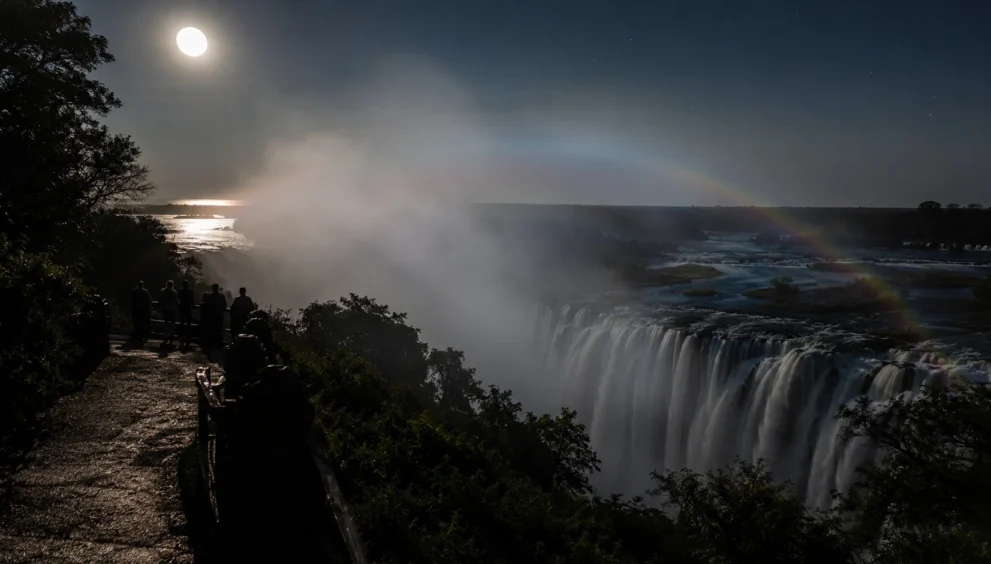
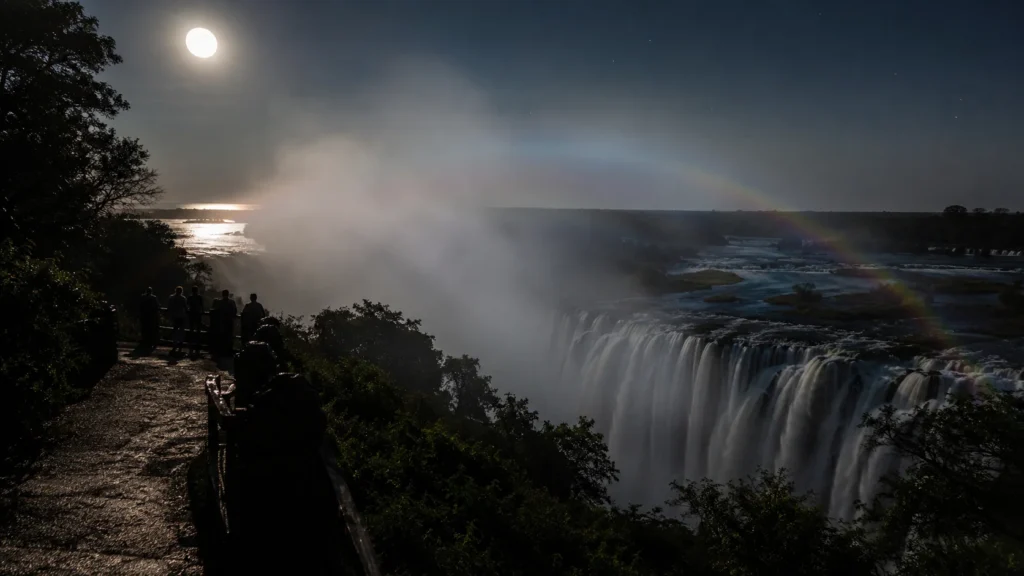
The first thing was the sound. Not the darkness. The sound—a low rumble that deepened into something felt in the chest, a compression of air and water and gravity that announced the falls before the falls announced themselves. There were no floodlights. Only the pale wash of a rising full Moon and the thick blue-black ink of the Zambian night. Water plunged more than 100 metres into the gorge, sending vast columns of spray into the air. Then, almost imperceptibly, a pale smudge appeared in the mist. A curve emerged. A soft, luminous band stretching across the darkness, suspended above the void.
This was the moonbow—a lunar rainbow formed not by sunlight but by moonlight. The physics is the same: refraction, reflection, and dispersion of light in water droplets. The conditions are rarer. The Moon must be near full and low in the sky. The skies must be cloud-free. Enough water droplets must be in the air. The observer must stand with the Moon behind them and the spray in front. Dr Kimberly Strong, a physics professor at the University of Toronto, calls it “a magical experience.” She is right. She is also describing a phenomenon that requires a specific alignment of celestial mechanics, atmospheric conditions, and human patience that almost no traveller is prepared to offer.
Victoria Falls—known locally as Mosi-oa-Tunya, “The Smoke That Thunders”—draws around one million visitors a year. The vast majority come in daylight. They cross the Knife-Edge Bridge, get drenched within seconds, photograph the curtain of white mist, and leave. A small number return after dark. Fewer still return during the full Moon period. The moonbow appears for a few hours on a few nights each month, usually between February and July, when the water volume and spray are strongest. Even then, there is no guarantee. The window is narrow. The phenomenon is fleeting. The crowd is almost nonexistent.
But the moonbow wasn’t the story. The story was Cultural Authenticity vs Commercial Experience—and what happens when a natural wonder is packaged for mass tourism by day but reveals its rarest phenomenon only to those who stay after the gates close.
The Two Falls
Victoria Falls is not one destination. It is two, separated by the setting of the sun. The daytime falls belong to the million. They are accessible, spectacular, and photographed from every angle. The infrastructure—the paths, the viewpoints, the Knife-Edge Bridge, the park fees—is designed for volume. The experience is extraordinary. It is also shared. The nighttime falls belong to almost no one. The park gates close. The floodlights do not exist. The only illumination is the Moon. The only people are those who bought a second ticket and returned.
The distinction is not natural. It is operational. The falls do not change at night. The spray still rises. The water still plunges. The moonlight still refracts. The difference is that the infrastructure of mass tourism—the buses, the queues, the ticketed viewpoints—does not operate after dark. The moonbow requires no additional construction. It requires only the absence of the crowd. The rarity of the experience is not a function of the phenomenon. It is a function of the visitor economy’s operating hours.
Omen Mudenda, a tour guide with Victoria Falls Expeditions, recommends booking a guided moonbow tour ahead of time, particularly during peak periods. “Many guests say it feels almost spiritual standing in the darkness, hearing the falls, feeling them, and suddenly seeing a rainbow created by moonlight,” he said. “It is a memory that stays with people for life.” The language is the language of the industry—”guests,” “booking,” “peak periods”—but the experience he describes is the opposite of industrial. It is solitary, uncertain, and dependent on conditions that no operator can control. The moonbow resists the packaging that the daytime falls have long since submitted to.
The Patience Premium
The writer who witnessed the moonbow had not planned to see it. She arrived at the park entrance at noon, exhausted from five weeks of driving solo across southern Africa. A parking attendant asked if she wanted him to hold her spot until that night. He explained that the full Moon was rising. This was one of the rare nights. So she bought two tickets—one for daylight, one for after dark.
The story is a reminder of how much of travel’s most valuable experiences depend on happenstance. A different border crossing. A longer delay. A decision to skip the night visit. The moonbow would have been missed. The traveller would never have known what she missed. The industry is built on the opposite principle. It promises certainty. Book this tour. Reserve this time. See this sight. The moonbow promises nothing. It appears, or it does not. The waiting is part of the experience. The uncertainty is part of the value.
The waiting that night was communal. A small group gathered along the dark path by 20:00, waiting for the Moon to rise high enough, for the light to align. “Now and then, someone eagerly pointed into the mist, convinced they’d spotted it; a faint arc that dissolved as quickly as it appeared.” The false sightings were not failures. They were anticipations. When the moonbow finally materialised, the reactions were quiet—”quiet gasps and half-laughed disbelief.” The moonbow had none of the sharpness of a daytime rainbow. Its colours were subdued, its edges softer. Cameras clicked softly, their long exposures revealing streaks of red, blue, and violet that the naked eye could not fully distinguish. The experience was not captured. It was approximated. The gap between the image and the memory is the gap that the industry cannot close.
Who Gains, Who Loses
The power recalibration is visible across multiple axes.
The million daytime visitors gain a spectacular waterfall. They see it in full light. They photograph it from every angle. They leave with the images that define Victoria Falls in the global imagination. They do not see the moonbow. Most do not know it exists.
The handful of nighttime visitors gain an experience that cannot be replicated by anyone who leaves before dark. The moonbow is not a secret. It is simply incompatible with the operating hours of mass tourism. The barrier to entry is not money—a second ticket costs little—but time, patience, and the willingness to stand in the dark waiting for something that may not appear.
Local guides and operators gain a product that differentiates them. The moonbow tour is not a volume business. It is a premium experience, sold to a small number of travellers who value rarity over convenience. The economics are not transformative for the destination. They are sustainable. The product cannot be scaled without destroying what makes it valuable. The darkness is the asset. The crowd is the enemy.
The destination gains a dual identity. Victoria Falls by day is one of the world’s great natural wonders, accessible to anyone with a park ticket. Victoria Falls by night is one of the few places on Earth where a moonbow can be seen with any regularity. The two identities coexist because they occupy different hours. The tension between them is latent. If the nighttime falls were ever floodlit, the moonbow would vanish. If the daytime crowd ever stayed past sunset, the solitude that defines the moonbow experience would vanish with it. The separation is fragile. It depends on the park gates closing, the buses leaving, and the million visitors accepting that they have seen what they came to see.
The 12-Month Trajectory
The moonbow will remain rare. The physics will not change. The full Moon will continue to rise. The spray will continue to refract. The conditions will continue to align for a few hours on a few nights each month. The number of people who witness it will remain small because the number of people willing to stand in the dark, damp, and uncertain, waiting for an arc of pale light that may never materialise, will remain small.
The tension between the daytime falls and the nighttime falls will not resolve. It does not need to. The moonbow does not compete with the postcard. It occupies a different register of experience. The industry will continue to sell the certainty of the daytime visit. The guides will continue to sell the possibility of the nighttime one. The two products are not in conflict. They are in parallel. The traveller who buys both tickets gets both. The traveller who buys only one never knows what the second would have revealed.